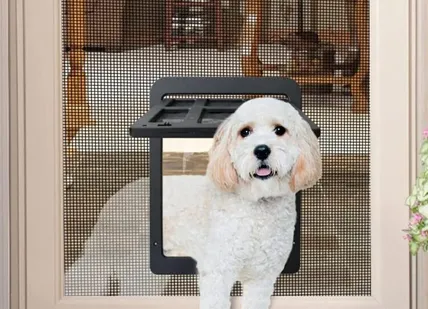
Smartex Screen’s current catalog has screen doors and pet-resistant mesh, but no screen door with a built-in dog flap. A dog-door version would most likely be a custom development project, not a stock item. This guide covers what to ask, what changes, and what to confirm before quoting.

Does Smartex Screen make a screen door with a built-in dog door?
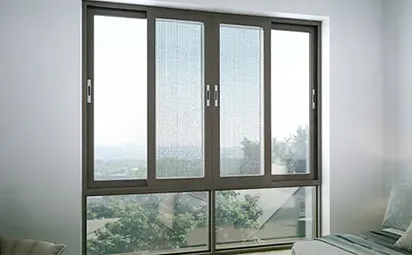
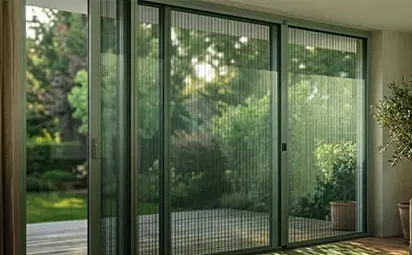
Our finished screen-door range covers magnetic, hinged, sliding, roller, retractable, side-to-side and pleated systems, with aluminum or model-specific frames. None of those product entries includes an integrated pet flap.
If your customers ask for this configuration, we treat it as a development request. Send us the door type, target opening sizes and the flap size you want, and we confirm feasibility before anything is quoted.
Why can’t the flap simply be cut into the mesh?
This is the most common misunderstanding in pet-door sourcing. A flap frame needs a rigid surround. Mesh alone has no stiffness, so a cut-out edge tends to sag, fray or pull away from the spline under repeated use by a dog.
Realistic options keep the flap in a solid panel or a reinforced frame section, and the mesh stays intact around it. That also means the flap’s location, the lower rail height and the door’s frame profile all have to be designed together. A flap that sits above a dog’s shoulder height is useless, and one that forces a very deep lower rail changes the door’s look and its packaging size.
Which mesh should a pet-door screen door use?
Standard fiberglass is the weakest match for a door that animals contact daily. Our pet-resistant range includes pet-resistant insect screen, heavy-duty polyester mesh and vinyl-coated polyester screen, with strength, weight and mesh count that vary by model.
Compared with common standard fiberglass-mesh screen doors, a pet-resistant mesh is the more suitable starting point, because the product description positions it for pet-friendly doors and high-traffic areas. We don’t publish a strength multiplier, puncture rating or service-life figure, since those need a test report for the exact model. Ask for the report before you put a number on a package.
Which build routes exist, and how do they compare?
| Dimension |
A. Stock pet-resistant mesh door, no flap |
B. Stock door plus end-user pet-door insert |
C. Custom door with integrated flap panel |
| In current catalog |
Yes, as a door system with compatible mesh |
Door and mesh yes; insert is not our product |
Nein |
| Development needed |
None beyond mesh selection |
Possibly a reinforced frame section |
Product structure, CAD, prototype, likely tooling |
| Who bears fit risk |
Us |
The buyer and the final customer |
Shared, confirmed at sample stage |
| Verkaufsverpackung |
Existing formats |
Adds a separate component to your SKU |
New carton and insert design |
| Indicative timeline |
Standard production lead time of about 30–45 days |
Depends on the frame change |
About 10–14 weeks for moderate development, 16–20 weeks for full ODM |
The timelines are general guidance figures, not commitments. Actual schedules depend on product, mold requirement, order quantity, materials, packaging and sample approval.
What does this mean for a wholesaler or retail chain?
Route A is the lowest-risk way to answer pet-owner demand today, but it doesn’t contain a flap. Route C could give you a differentiated SKU, though it pushes you into sample approval and a longer lead time.
Finished kits are publicly presented with an MOQ of approximately 500–1,000 sets, and a custom door will likely sit at or above that. Custom colors and private-label packaging, barcodes and multi-language manuals are available through our OEM and ODM service. Confirm the exact MOQ for your configuration.
What should you send us to get a usable quote?
- Door type. Hinged, sliding, magnetic or another system from our screen-door range.
- Opening sizes. Standard sizes or custom dimensions, since the flap position depends on door height.
- Flap spec. Target flap dimensions and, if you have one, the insert you plan to use.
- Mesh. Pet-resistant, heavy-duty polyester or vinyl-coated polyester, plus color.
- Channel and packaging. Retail-ready, e-commerce, DIY kit or project packaging, and whether you need private labeling.
- Compliance needs. Which markets you sell into, so we can check which documents apply to the exact model.
Pricing is quotation-based and depends on model, material, mesh specification, size, color, packaging, customization level, mold requirements, order quantity and shipping terms. We don’t publish a price range for this configuration. Paid samples are available for certain products or customized samples, and the sample policy refers to approximately USD 50–200.

Which compliance claims can you rely on?
REACH, RoHS and CE are referenced for parts of our portfolio. The scope varies by product, and the certificate numbers, issuing bodies and tested models need to be checked for the exact door and mesh you choose. Don’t copy a company-level certification claim onto a new SKU before you’ve seen the matching document.
FAQ
Can I order a screen door with a dog flap from Smartex Screen today?
There is no such door in our catalog. We can discuss it as a custom development project after you share the door type, sizes and flap requirements.
Is pet-resistant mesh enough for a door used by dogs?
It’s a better starting point than standard fiberglass, but no strength figure is published without the exact model’s test report.
How long would a custom pet-flap door take?
General guidance is about 10–14 weeks for moderate development and 16–20 weeks for full ODM development, with actual timing confirmed per project.
Wie hoch ist die Mindestbestellmenge?
Finished kits are publicly presented at approximately 500–1,000 sets. Confirm the figure for your configuration.
Next step if I want to proceed?
Send the six items listed above and ask for a feasibility check before requesting a price. Pet-flap door dimensions per dog size and any required test documents are the two questions worth settling first.


















 09:32