La malla para piscinas se clasifica por su densidad: el número de hilos por pulgada en cada dirección. Las 17×14 y 18×14 son los tejidos más abiertos; las 20×17 y 20×20, los más cerrados. El gramaje no va ligado a la densidad: solo nuestros modelos 20×20 oscilan entre unos 176 y 305 g/m² según su construcción.
La mayoría de las descripciones de mallas para piscinas presentan un solo rollo a la vez. Esto funciona para un propietario que solo necesita reemplazar un panel, pero no para un distribuidor que debe decidir qué tres o cuatro tramas tener en inventario, ni para un fabricante que necesita saber cuánto pesará un palet de 20×20 antes de despacharlo.
| Número de mallas |
Ejemplo de modelo |
Material |
Peso aprox. del tejido |
Peso del tejido por 1.000 m² |
Diámetro de alambre publicado |
| 17×14 |
Malla protectora para piscinas de alta resistencia |
Confirmar según el modelo |
No publicado |
No publicado |
No publicado |
| 17×14 |
De alta resistencia y alta visibilidad |
Confirmar según el modelo |
~133 g/m² (≈3,9 oz/yd²) |
~133 kg |
No publicado |
| 18×14 |
Mosquitero para piscina |
Confirmar según el modelo |
No publicado |
No publicado |
No publicado |
| 20×17 |
Criba de alta resistencia |
Poliéster |
No publicado |
No publicado |
No publicado |
| 20×20 |
De alta resistencia y alta visibilidad |
Confirmar según el modelo |
~176 g/m² (≈5,2 oz/yd²) |
~176 kg |
No publicado |
| 20×20 |
Malla contra mosquitos |
Confirmar según el modelo |
~215 g/m² (≈6.3 oz/yd²) |
~215 kg |
~0,013 pulg. |
| 20×20 |
Criba de alta resistencia |
Confirmar según el modelo |
~305 g/m² (≈9.0 oz/yd²) |
~305 kg |
No publicado |
En la línea de productos para piscinas y patios, los materiales incluyen fibra de vidrio, poliéster y poliéster recubierto de vinilo, según el modelo. La misma línea también incluye mallas para piscinas resistentes a las mascotas, mallas tipo Tuff y tejidos de protección solar en opciones 80% y 90%.

Cómo interpretar el número de malla sin equivocarse
“17×14” significa 17 hilos por pulgada en una dirección y 14 en la otra. El detalle está en la dirección: no todos los proveedores indican primero la urdimbre, por lo que 17×14 y 14×17 pueden describir la misma tela. Al comparar dos fichas técnicas, comprueba a qué dirección corresponde cada número antes de considerarlos productos diferentes.
El número de malla se mide por pulgada, mientras que el peso de la tela suele expresarse en g/m². Los compradores estadounidenses suelen pedirlo en oz/yd², por eso la tabla muestra ambas unidades.
Why does one mesh count cover a 129 g/m² spread?
Our three 20×20 models weigh roughly 176, 215 and 305 g/m². Same count, and the heaviest is about 1.7 times the lightest.
Mesh count only tells you how many strands sit in an inch. It says nothing about how thick each strand is, what the yarn is made of, or how much coating it carries. Those variables set the weight, the look of the fabric, and how it handles during installation. The 0.013-inch wire diameter published for our no-see-um model is one data point, and it belongs to that model only.
The common mistake: a distributor sources “20×20 pool screen” from two suppliers and lists them as interchangeable. They may not be. One could be an enhanced-visibility construction near 176 g/m², the other a heavy-duty fabric near 305 g/m². Freight cost, roll handling and how the fabric behaves in your customers’ frame systems will all differ. Order a sample of each before you merge them under one SKU.
Compared with the window-grade fiberglass insect screen most distributors already stock, pool mesh sits at the heavier end. Custom options in our fiberglass insect screen line fall within roughly 80–140 g/m². The pool-screen examples above start around 133 g/m² and reach about 305 g/m².
Matching Mesh Count to the Job
These pairings follow the applications each model is presented for. They are starting points for a stocking plan, not performance guarantees.
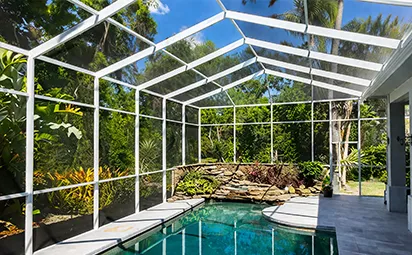
- General pool enclosure, patio and porch rescreening: 17×14 or 18×14, the more open weaves in the range.
- No-see-um protection: the 20×20 no-see-um model (~215 g/m²) is the construction we designate for this use.
- Customers who prioritize a clear view: the enhanced-visibility constructions, available in 17×14 (~133 g/m²) and 20×20 (~176 g/m²).
- Customers asking for a heavier fabric: the 20×20 heavy-duty (~305 g/m²) or the 20×17 heavy-duty polyester.
- Sun and heat control: 80% or 90% solar screen fabrics.

Specify Roll Size Before You Request a Quote
Roll width and length are model-specific and customizable, so the quote depends on what you send us. Pool screen pricing is quotation-based. It moves with mesh count, material, fabric weight, roll dimensions, color, packaging, customization level, order quantity, destination market and shipping terms. A quote request that pins these down comes back faster and more accurate.
- Pick the row. Choose the mesh count and the specific model from the table, not just the count.
- Set roll width, roll length and rolls per SKU. Run the weight math early. As an illustrative calculation (not a standard roll size): a 2.5 m × 30 m roll holds 75 m² of fabric, which is about 22.9 kg at 305 g/m² and about 10.0 kg at 133 g/m².
- Choose standard or custom color. Custom colors are available, and they change the MOQ (see step 6).
- Define packaging. Export bulk packing, retail-ready rolls, or private-label packaging with your branding and barcodes.
- Order a paid sample and check it against the spec sheet. Sample fees run about USD 50–200 for certain products or customized samples. That is a sample charge, not the selling price of the mesh.
- Confirm MOQ and lead time in writing. Our published reference MOQ for screen mesh is about 5,000 m², rising to roughly 10,000–20,000 m² for custom-color fabric. Standard production lead time is about 30–45 days. Both vary by model, color, packaging and customization, so treat them as starting figures.

Compliance Paperwork Is Model-Specific
Parts of our pool-screen portfolio reference Florida Building Code-related claims, UL GREENGUARD Gold certification for selected materials, QUV accelerated weathering testing, and EU REACH and RoHS requirements. None of these automatically covers every row in the table above.
If your market requires documentation, request it for the exact model you are buying and check that it states:
- the certificate or test report title and number
- the issuing or testing organization
- the tested product, model and material
- the standard version and issue date
- the expiry date and markets covered
Para más información, contáctenos.
Preguntas frecuentes
What is the difference between 17×14 and 20×20 pool screen?
The count of strands per inch. 17×14 is a more open weave; 20×20 is tighter, and our 20×20 no-see-um model is the one we designate for no-see-um protection. Weight depends on construction, not count alone.
Is 20×20 pool screen always heavier than 17×14?
No. Our 20×20 models range from about 176 to 305 g/m², and our 17×14 enhanced-visibility model is about 133 g/m². Compare model weights, not mesh counts.
Can you customize roll width and length?
Yes. Roll size is model-specific and customizable. Send the width, length and rolls per SKU you need, and we confirm feasibility for that model.
What is the minimum order for pool screen mesh?
Our published reference MOQ for screen mesh is about 5,000 m², and about 10,000–20,000 m² for custom-color fabric. The exact MOQ depends on model, color, packaging and customization and is confirmed at quotation.
¿Cuánto cuesta la malla para cerramientos de piscinas?
El precio se determina mediante cotización y depende del modelo, el material, el número de malla, el peso, el tamaño del rollo, el color, el embalaje, la cantidad y las condiciones de envío. Las muestras pagadas cuestan aproximadamente entre 50 y 200 USD para ciertos productos; ese no es el precio del producto.
¿Sus cerramientos para piscinas cumplen con el Código de Construcción de Florida?
Las referencias relacionadas con el Código de Construcción de Florida se aplican únicamente a determinadas aplicaciones de cerramientos para piscinas. Solicite el documento correspondiente al modelo exacto que planea comprar y verifique su alcance antes de utilizarlo en su material de marketing.

















 09:37

