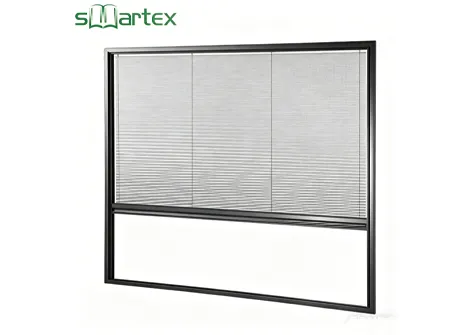
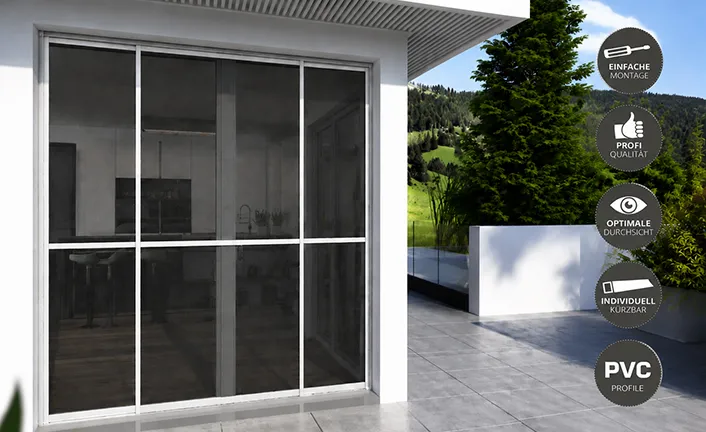
A retractable screen door pulls its mesh out of a side-mounted cassette and back in again; a side-to-side roller fly screen door runs on a fixed track with no retracting housing at all. Mounting depth, compatible mesh weight, and maximum opening width all follow from that one structural choice.
Two Mounting Logics, Not One Product Category
“Retractable screen door” gets used loosely across sourcing conversations to mean almost any screen that isn’t a rigid framed panel. For a fabricator building it into a door line, or a distributor stocking it against a catalog, that looseness causes spec mismatches later. Two structurally distinct systems sit under the term:
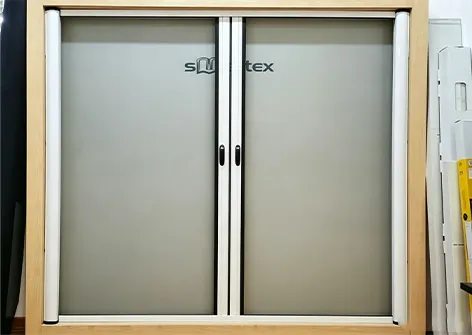
- Cassette retractable screens. The mesh, a pull bar, and a tension spring live inside an aluminum housing mounted to one jamb. Pulling the bar draws mesh across a bottom guide track; releasing it (or triggering a motor) retracts the mesh back into the housing.
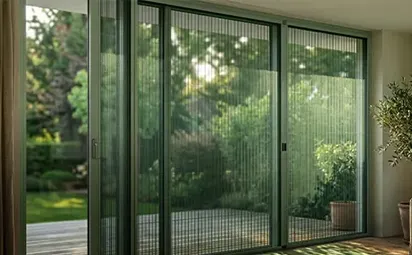
- Side-to-side roller fly screen doors. The screen panel rides on upper and lower tracks the full width of the opening, similar to a sliding patio door. There is no retracting housing — the panel slides open and closed along the track rather than disappearing into a cassette.
Both appear in Smartex’s finished screen door line, and both get specified against door-system catalogs differently. A cassette retractable is chosen when the buyer wants the screen invisible when not in use. A side-to-side roller is chosen when a simpler, lower-part-count mechanism fits the price point or the opening doesn’t need the screen to disappear.
Housing Depth and Track Mounting
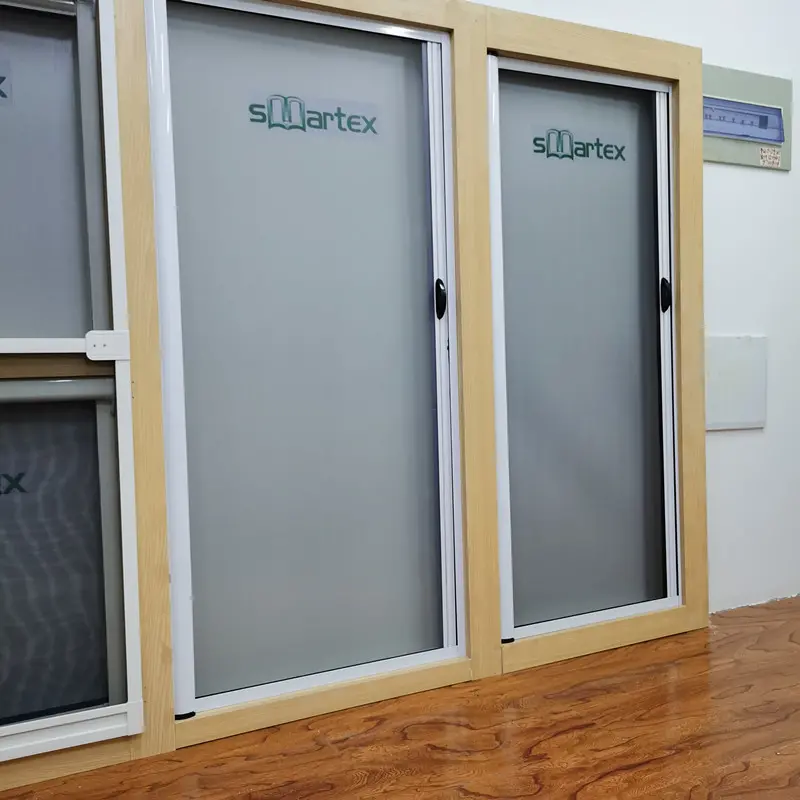
Cassette depth is the first number a fabricator needs before the door frame design is finalized, because the housing has to sit inside or beside the jamb without interfering with existing hardware. Manual cassette systems in the broader market commonly run in the 1.5 to 2 inch depth range; motorized versions need more room for the motor and gearing, often 4 to 6 inches. Those figures describe general market practice, not a confirmed Smartex housing dimension — the exact cassette profile for a given order is a drawing-and-quotation item, not a catalog constant, since housing size scales with mesh width and spring tension.
Side-to-side roller doors avoid the cassette-depth question entirely. Their constraint is track depth at the head and sill instead — shallow, but it runs the full width of the opening rather than concentrating at one jamb.
A common oversight during system selection: assuming the same mounting depth applies whether the door will be manual or motorized. If a project brief hasn’t specified operation type yet, cassette depth shouldn’t be locked into the frame design.
Mesh Compatibility by System Type
Not every mesh in a catalog fits every housing. A cassette has to roll and unroll the mesh cleanly thousands of times, which limits how stiff or heavy a fabric can be before it jams or wears the spring mechanism. A side-to-side roller door, since the mesh stays flat in its track rather than coiling, tolerates heavier or stiffer fabric with less mechanical concern.
Smartex’s screen mesh range maps to this split:
- Fiberglass mesh — standard weight, coils cleanly, the default choice for cassette retractable systems.
- Polyester and vinyl-coated polyester mesh — heavier and more tear-resistant, better suited to side-to-side roller doors or reinforced cassette systems built for pet households or high-traffic entries.
- Pleated mesh — folds rather than coils, so it belongs to a third door type (pleated/plisse screen doors) and isn’t interchangeable with either cassette or roller hardware.
- High-visibility mesh — thinner strand profile for sightline-sensitive installs; performs well in both cassette and roller systems since coil stiffness isn’t the limiting factor.
Buyers specifying pet-resistant mesh for a cassette door should confirm the housing’s roller diameter and spring rating against the heavier fabric weight before assuming a drop-in fit — mesh and hardware are typically matched at the factory, not swapped freely in the field.
Opening-Width Limits
Width capacity on a cassette retractable is governed by the housing’s roller diameter and spring tension, not the track alone — wider openings need a larger-diameter roller to hold enough mesh without overloading the spring, which is why cassette housings scale up in size as width increases. Side-to-side roller doors scale differently: width is closer to a linear constraint of track length and panel rigidity, which is part of why they’re often the simpler choice for openings wider than a standard single door.
Exact width ceilings differ by hardware supplier and aren’t a single industry number. For Smartex-supplied systems, maximum width for a given mesh and housing combination is confirmed at the quotation stage against the buyer’s target opening, not published as a flat maximum across the catalog.
Comparison Table
| Attribute |
Cassette Retractable (Manual) |
Cassette Retractable (Motorized) |
Side-to-Side Roller Fly Screen |
| Housing/Track Type |
Side-mounted coiling cassette |
Side-mounted cassette with motor |
Top-and-bottom sliding track; no cassette |
| Typical Mounting Depth |
Shallow—general market range: 1.5–2 in.; confirm the exact profile via drawing |
Deeper—general market range: 4–6 in.; confirm via drawing |
Shallow at the head and sill; runs across the full opening width |
| Mesh Best Suited To |
Fiberglass, high-visibility mesh, and lighter polyester |
Fiberglass, high-visibility mesh, and lighter polyester |
Polyester, vinyl-coated polyester, and heavier fabrics |
| Width Scaling Factor |
Roller diameter and spring tension |
Roller diameter, spring tension, and motor torque |
Track length and panel rigidity |
| Housing Visible When Open |
No—retracts fully |
No—retracts fully |
Yes—the panel stacks visibly at one side |
| Typical Sourcing Fit |
Doors where a hidden screen is a stated requirement |
Same as the manual version, plus projects requiring remote or button operation |
Simpler mechanism with fewer moving parts; often offers a lower landed cost per unit |
Compared with pre-assembled single-spec systems sold as one fixed configuration, mesh weight, frame color, and housing profile on these two system types can each be adjusted separately against a buyer’s own catalog, which is the main reason fabricators source components rather than finished retail units.
How to Specify Before Placing an Order
- Measure the clear opening, not the frame. Door hardware, weatherstripping, and any fixed panel reduce the usable width below the raw frame dimension.
- Decide manual or motorized before finalizing frame depth. The housing depth difference between the two is large enough to affect jamb design.
- Match mesh weight to end-use. Pet households and high-traffic commercial entries generally call for polyester or vinyl-coated polyester; standard residential use is typically served by fiberglass.
- Confirm width against the specific hardware set being quoted, not a general catalog maximum, since roller diameter and track length both factor into the real ceiling.
- Flag private-label or packaging requirements at the same stage as the technical spec, since carton design and instruction-sheet language are easier to lock in alongside the mesh and frame decision than after tooling is set.
Where Buyers Get the Spec Wrong
The most frequent mismatch isn’t mesh or color — it’s treating “retractable screen door” as one interchangeable line item when quoting multiple suppliers. A cassette retractable and a side-to-side roller door solve the same problem (screening an opening without a permanent panel) with different mechanisms, different depth requirements, and different mesh tolerances. Requesting quotes under a single generic spec sheet often produces prices that aren’t actually comparable, because one supplier may be quoting cassette hardware and another roller hardware against the same line item.
A second, smaller misconception: assuming a pet-resistant mesh upgrade is a drop-in swap on an existing cassette order. Because housing and spring components are typically sized to the mesh weight at the factory, a mesh change mid-order can mean a hardware change too — worth confirming before assuming it’s a one-line revision.
Compliance Notes for Screen Door Mesh
Mesh materials used across cassette and roller screen door systems fall under general REACH and RoHS compliance scope for screen products. Certificate numbers, issuing bodies, and the exact tested model still need confirmation for whichever specific door system is being quoted — compliance documentation isn’t automatically identical across every product on a catalog page.
Sourcing Retractable and Roller Screen Doors from Smartex
Smartex supplies both cassette retractable and side-to-side roller fly screen doors as components for private-label and OEM/ODM programs, not only as assembled retail units. That includes mesh selection, frame color matching, packaging format (assembled, semi-assembled, or component kit), and instruction-manual language. Finished-kit sourcing typically runs against an MOQ in the 500–1,000 set range; sample fees for evaluation units generally fall in the USD 50–200 range depending on configuration. Exact pricing is quotation-based against the specific mesh, frame, and packaging combination selected — it isn’t a fixed per-unit number that applies across every door configuration.
Fabricators building a door-system catalog around a specific hardware set, or distributors deciding which of the two mechanisms fits a given price tier, are usually better served starting from a technical drawing than a general spec sheet, since so much of the real comparison — depth, roller sizing, width ceiling — is hardware-specific rather than catalog-wide.
Preguntas frecuentes
What’s the main difference between a retractable screen door and a side-to-side roller fly screen door?
A retractable screen door coils its mesh into a side-mounted cassette and disappears when not in use. A side-to-side roller fly screen door slides along a fixed top-and-bottom track and stays visible, similar to a sliding patio door panel.
How much mounting depth does a retractable screen door cassette need?
A: General market practice puts manual cassette systems around 1.5–2 inches and motorized systems around 4–6 inches, but the exact depth depends on mesh width and roller sizing for the specific hardware being quoted — confirm against a technical drawing before finalizing frame design.
Can pet-resistant mesh be used in a retractable cassette system?
Yes, but the housing’s roller diameter and spring rating need to match the heavier mesh weight. It’s a hardware-and-mesh pairing decided at the factory rather than a field swap.
Is there a maximum width for a retractable screen door?
Width capacity depends on roller diameter, spring tension, and (for motorized units) motor torque rather than a single published figure. Confirm the ceiling against the specific hardware combination being quoted.
What’s the MOQ for sourcing retractable or roller screen doors from Smartex?
Finished-kit orders typically run in the 500–1,000 set range, with sample fees generally in the USD 50–200 range; final MOQ and pricing depend on mesh, frame, and packaging configuration and are confirmed at quotation.
Do retractable and roller screen doors carry the same certifications as screen mesh?
Mesh materials fall under general REACH and RoHS compliance scope, but certificate numbers and issuing bodies are confirmed per specific model rather than applied uniformly across the door-system catalog.
Buyers weighing a mixed order — cassette retractable for standard openings, side-to-side roller for oversized ones — should request separate technical drawings for each mechanism rather than one combined spec sheet; the depth and width variables don’t share a single reference point between the two systems.




















 15:49
15:49