Scegli la rete per la copertura della piscina in base alla posizione, non all'etichetta. Usa la trama 17×14 o 18×14 sulle pareti dove il passaggio dell'aria e la visuale sono fondamentali, la 20×20 no-see-um dove il problema sono i moscerini, un tessuto più resistente nelle zone del tetto e delle porte, e lo schermo solare 80% o 90% solo sui pannelli esposti al sole. Consulta la grammatura del tessuto per ciascun modello.
Non esiste una zanzariera migliore in assoluto per la copertura della piscina
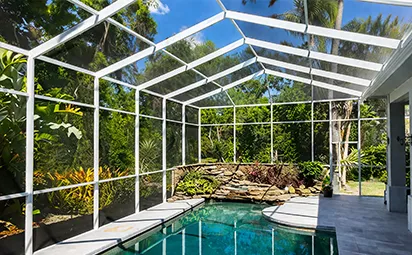
Una copertura per piscina svolge diversi compiti sotto un'unica struttura. Il tetto è esposto al sole diretto e alla caduta di detriti. I pannelli delle pareti definiscono la visuale e la ventilazione. Le porte e i pannelli inferiori sono soggetti a urti da parte di persone, animali domestici e attrezzature per la piscina. Un solo tipo di rete raramente riesce a gestire al meglio tutte e tre le esigenze, motivo per cui alla domanda su quale sia “la migliore rete per la copertura della piscina” ogni installatore darà una risposta diversa.
Reti per piscina e patio della nostra gamma: modelli e numeri
Fondata nel 2005, Smartex Screen tesse e riveste direttamente i propri tessuti per schermature. A seconda del modello, la linea per piscina e patio impiega fibra di vetro, poliestere o poliestere rivestito in vinile. La tabella riporta gli esempi presentati pubblicamente. Ogni riga corrisponde a un singolo prodotto e nessuno dei valori si applica alla linea nel suo complesso.
| Esempio di modello |
Densità della maglia |
Peso indicato |
Note |
| Rete per piscina, versioni standard e ad alta resistenza |
17×14 |
Confirm per version |
General-purpose count for large openings |
| Ad alta resistenza con visibilità migliorata |
17×14 |
approx. 133 g/m² |
Lightest displayed example in the line |
| Zanzariera per piscina |
18×14 |
Da confermare per modello |
Close to 17×14 in opening shape |
| Heavy-duty polyester screen |
20×17 |
Da confermare per modello |
Finer than 17×14, rectangular opening |
| Rete antimoscerini |
20×20 |
approx. 215 g/m² |
Displayed wire diameter approx. 0.013 inch |
| Ad alta resistenza con visibilità migliorata |
20×20 |
approx. 176 g/m² |
Square opening, lighter than the other 20×20 examples |
| Rete ad alta resistenza |
20×20 |
approx. 305 g/m² |
Heaviest displayed example in the line |
| Pet-resistant pool screen |
Specifico per modello |
Specifico per modello |
Strength data comes from the model’s test report |
| Solar screen, 80% and 90% options |
Specifico per modello |
Specifico per modello |
Confirm what the percentage measures |
Which mesh goes where? A zone-by-zone map
| Zone |
What it faces |
Mesh to shortlist |
Check before ordering |
| Roof panels |
Direct sun, debris |
20×20 heavy-duty (approx. 305 g/m²), 20×17 heavy-duty polyester |
Weathering test report for that exact model |
| Side walls |
Breeze and sightlines |
17×14 or 18×14; 17×14 enhanced-visibility (approx. 133 g/m²) |
Weight and open-area data for the model |
| Doors, lower panels, pet areas |
Contact, claws, equipment |
Pet-resistant pool screen; heavy-duty options |
Test report before repeating any strength claim |
| Sun-facing panels |
Glare and heat load |
80% or 90% solar screen |
What the percentage means and how it was tested |
| Zones where tiny insects are the complaint |
Moscerini no-see-um |
20×20 no-see-um (circa 215 g/m²) |
Compromesso tra flusso d'aria e visibilità per il modello |
Nulla vieta a un progettista di utilizzare reti diverse su una stessa struttura. Ciascuna corrisponde a un rotolo separato, quindi l'ordine viene semplicemente suddiviso per zona. La fila del tetto è quella in cui la grammatura del tessuto merita maggiore attenzione, poiché quel pannello sopporta il carico maggiore di sole e detriti; la tabella è una rosa di opzioni iniziale, ma è la scheda tecnica del modello a fare fede.
17×14 contro 20×20: a cosa si rinuncia
Il primo numero indica i fili per pollice in una direzione, mentre il secondo si riferisce a quelli nell'altra. Una rete 17×14 presenta quindi un'apertura rettangolare, mentre una rete 20×20 ne ha una quadrata e più piccola.
L'apertura più piccola è il motivo per cui esistono le zanzariere no-see-um: rappresentano la soluzione ideale per chi lamenta l'intrusione di insetti minuscoli. Lo svantaggio è che un numero maggiore di fili per pollice riduce la superficie aperta, limitando il passaggio dell'aria e la visibilità rispetto a una trama 17×14 o 18×14 di struttura analoga. Non esiste una percentuale unica applicabile a tutti i modelli, pertanto è consigliabile verificare i dati relativi alla superficie aperta per la coppia specifica messa a confronto.
La scelta dipende dall'esigenza specifica. Se il problema sono i moscerini (no-see-um), un pannello a parete 17×14 non sarà d'aiuto. Se invece il problema è un ambiente poco areato, installare una rete 20×20 su ogni pannello peggiorerà la situazione. Alternare le trame a seconda della zona permette di evitare entrambi i problemi.

Mesh count does not tell you the fabric weight
Three 20×20 products in our displayed examples weigh approximately 176, 215 and 305 g/m². That is a spread of roughly 130 g/m² at the same mesh count. A buyer comparing “20×20” quotes line by line may be comparing three different fabrics.
A usable quote comparison lists four items per line: mesh count, fabric weight, material and roll size. Weight is also not a strength rating.
Where 80% and 90% solar screen belongs
Solar screen is offered in 80% and 90% options. It belongs on specific panels, usually the ones that face the afternoon sun, rather than across the whole cage. The trade-off is the one you would expect: a screen made to cut solar load also cuts light and view, so a full-cage installation changes how the enclosure feels. Ask the supplier what the percentage refers to and what test basis stands behind it before you put the number in a catalog.

Six steps to specify a pool cage screen order
- Split a typical enclosure into zones: roof, walls, doors and lower panels, sun-facing panels.
- Shortlist one mesh per zone from the tables above, written as count, weight and material.
- Request the spec sheet for each model. For any claim you plan to repeat, such as Florida Building Code-related references, GREENGUARD Gold, QUV weathering tests, REACH, RoHS or CE, request the report itself and read which exact model it covers, who issued it, its number and whether it is still valid. Our catalog references these for parts of the pool-screen portfolio, and scope is confirmed model by model.
- Order samples. Some products and customized samples carry a sample fee, with the FAQ referencing approximately USD 50 to 200. That figure is sample policy and not a product price.
- Confirm roll width and length, which can be customized, and the MOQ. A publicly presented example for screen mesh is approximately 5,000 m², and it varies by material, model, color, packaging and customization.
- Confirm lead time. Website guidance puts standard production at approximately 30 to 45 days and simple customization at approximately 6 to 8 weeks, to be confirmed per order.
Pricing is quotation-based. Mesh count, fabric weight, roll width and length, color, packaging, customization level, order quantity, shipping terms and destination market all move the number.
FAQ
What mesh count is used for a pool cage?
In our pool and patio range, 17×14 and 18×14 are the general-purpose counts for large openings. 20×17 and 20×20 are finer options, with 20×20 no-see-um offered for small-insect protection.
Can one enclosure use more than one mesh?
Yes. Each mesh is a separate roll, so the order splits by zone. Typical splits are heavier fabric on the roof, a lighter or enhanced-visibility mesh on the walls, and solar screen on sun-facing panels.
Does a higher mesh count mean a stronger fabric?
No. Three 20×20 examples in our range sit at roughly 176, 215 and 305 g/m². Count describes the opening, while weight and material describe the fabric. Strength claims need a test report for the specific model.
Is 80% or 90% solar screen right for the whole cage?
It is specified for particular panels. Check what the percentage measures and the test basis, then decide how much light and view you are willing to trade away on each panel.
What does pool cage screen cost per roll?
Pricing is quotation-based and depends on mesh count, fabric weight, roll size, color, packaging, customization, quantity, shipping terms and destination. We do not publish a price range.
Can you customize mesh count and weight for private label?
Custom mesh count, weight, stiffness, roll dimensions, packaging, barcodes and multi-language instructions are part of our OEM and ODM scope. Website guidance for development runs approximately 6 to 8 weeks for simple customization, 10 to 14 for moderate development and 16 to 20 for full ODM, all confirmed per project.

















 08:57