A застежка-молния is an outdoor roller blind whose fabric edges carry a zip-style strip that locks into aluminum side guides. The locked edges keep the fabric held in the guides along its full height, which separates it from wire-guided or free-hanging blinds. Buyers specify it by fabric, zip edge, guide, cassette and operation.

The 5 Components That Decide How a Zip Blind Performs
When two zip blinds look identical in a showroom photo, the differences usually sit inside the guide and the cassette. Comparing quotations component by component is the most reliable way to see what you are actually buying.
Полотно
The fabric sets the function. Outdoor shading fabrics are selected for openness (how much light and view pass through), color, and the job the blind has to do: shading, glare control, privacy or insect control. A darker fabric generally gives better outward visibility from inside; a lighter one reflects more light. The trade-off between view and privacy is the first decision to settle with your end customer, because it determines which fabric family you sample.
Fabric thickness also affects the rest of the system. A heavier fabric rolls up into a larger diameter, which can change the cassette size required for the same drop.

Zip edge
The zip strip is attached along each side edge of the fabric. Its job is to stay inside the guide when wind pushes on the fabric face. This is the part buyers most often overlook during sampling. Check how evenly the strip runs along the full length of the fabric, whether it sits flat after rolling and unrolling, and whether the attachment holds up when you tug the fabric sideways by hand. A wavy or loosely attached strip shows up later as jamming in the guide.
Side guides and bottom bar
The aluminum side guide contains an insert that captures the zip strip. Guide depth, insert material and the internal profile all affect two things you can feel on a sample: how smoothly the blind runs, and how much force it takes to pull the fabric out sideways. Guides can be face-fixed to a wall or post, or fitted inside a reveal, and that choice changes how you measure (see the step list further down).
The bottom bar runs inside the same guides and gives the fabric weight and a straight lower edge. On a patio with an uneven floor, the bottom bar is where gaps appear first.
Cassette (headbox)
The cassette houses the roller tube and the rolled fabric. Its size follows the drop and the fabric thickness, so a tall opening with heavy fabric needs a larger box. Buyers supplying retrofit projects should check the available space above the opening early. A cassette that does not fit under an existing beam or soffit is one of the more expensive surprises at installation.
Operation: manual or motorized
Zip blinds are supplied in manual or motorized versions, depending on the model. Manual versions avoid wiring and suit smaller openings or budget-driven projects. Motorized versions suit large or hard-to-reach openings, pergola sides and projects where several blinds are controlled together, but they need a power supply routed to the cassette position. That routing has to be planned before installation, not after. The control system, motor type and accessories are confirmed per model at quotation.
What Our Zip Blind Range Covers
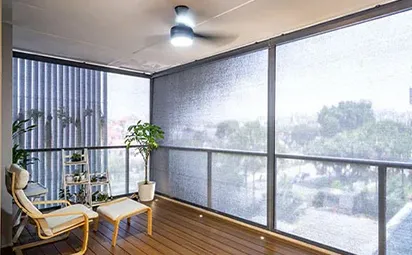
We list zip blinds under several product names: zip blind, zip screen, zip track blind, outdoor zip screen blind, motorized and manual zip blinds, and patio, balcony and pergola zip screens. The table below shows what is configurable. It is a scope table, not a performance specification.
| Параметр |
What we offer |
| Управление |
Motorized or manual, depending on the model |
| Полотно |
Product-specific outdoor shading fabric |
| Размеры |
Customized to the opening and project |
| Fabric color |
Standard or customized |
| Frame and guide color |
Standard or customized |
| Installation locations |
Windows, patios, balconies, pergolas, outdoor enclosures, project openings |
| Functions |
Shading, glare reduction, privacy, insect control, wind-management support |
| Интеграция перголы |
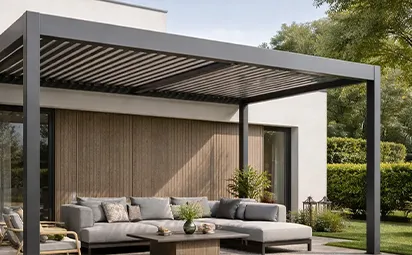
Zip blinds can be specified as side enclosures on our aluminum pergolas |
Maximum width and drop, fabric openness values, motor specifications and any wind-test data are model-specific.

Zip Blinds Compared With Other Outdoor Blind Types
Compared with common wire-guided and free-hanging outdoor roller blinds, a zip blind adds a captured edge, which changes both what it can do and what it demands from the installation.
| Фактор |
Штора-плиссе на молнии |
Wire-guided outdoor blind |
Free-hanging outdoor roller blind |
| Fabric edge |
Captured in an aluminum guide |
Fabric held in place by tensioned side wires; edges open |
Edges unsupported |
| Side gaps |
Closed along the guide |
Visible gap between fabric edge and opening |
Gap and edge movement |
| Insect control at the sides |
Possible when the fabric and seals suit it |
Limited by open edges |
Not designed for it |
| Behavior in wind |
Fabric stays in the guides up to the model’s design limit |
Fabric can flap between wires |
Usually raised in wind |
| Installation tolerance |
Needs plumb, parallel guides |
More forgiving |
Most forgiving |
| Components per opening |
Fabric, zip edge, two guides, bottom bar, cassette, drive |
Fabric, wires, brackets, bottom bar, drive |
Fabric, brackets, bottom bar, drive |
The extra guides and zip edge are why zip blinds are usually quoted above simpler outdoor roller blinds of the same size. Whether that difference is worth paying depends on whether your customer needs closed edges.
Where a Zip Blind Is the Wrong Choice
The most common misconception is that a zip blind turns a patio into a sealed room. It does not. A zip blind is not a waterproof or windproof wall, and marketing that implies otherwise creates warranty disputes later. Every model has a wind design limit, and the usual operating advice is to retract the blind in strong wind regardless of the edge system.
A few other conditions deserve an honest conversation before you order:
- Out-of-plumb openings. If posts or walls lean, the two guides will not run parallel, and the fabric binds or the zip strip pulls out. The structure may need packing or a sub-frame first.
- Dusty or leaf-heavy sites. Debris collects in the guides and increases friction. End users need to know the guides require periodic cleaning.
- Openings that may change. A zip blind is made to size. Reusing it on a different opening usually means new guides and new fabric.
- No power at the head position. Motorized units need a planned cable route. Adding it after finishing work is costly for the installer.

How to Specify a Zip Blind for a Quotation
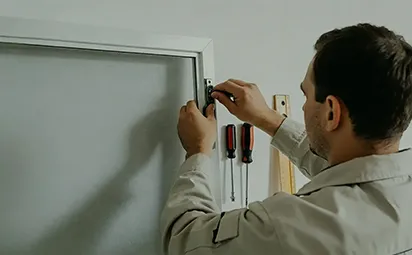
A clean specification shortens the quoting cycle and reduces the risk of a wrong-size production run. These are the steps we ask buyers to follow for each opening:
- Decide the mounting type. Face-fixed (guides on the outer face of the wall or post) or reveal-fixed (guides inside the opening). The measurement rules differ.
- Measure the width at three heights. Top, middle and bottom. For reveal mounting, use the smallest figure. Record all three, since a large difference signals an out-of-square opening.
- Measure the drop on both sides. Left and right, from the cassette fixing point to the floor or sill. Differences point to an uneven floor that the bottom bar will reveal.
- Check the space above the opening. Note the available height and depth for the cassette, including any beam, gutter or soffit.
- Confirm the guides can run plumb. Use a level on both fixing surfaces. Note any lean so we can advise on packing or sub-frames.
- Choose the fabric function. Shading, privacy, glare control or insect control, plus a fabric color.
- Choose frame and guide color. Standard or custom.
- Choose manual or motorized operation. For motorized units, note where power is available and how the blinds should be controlled.
- State quantity, packaging and market. Project packaging, retail packaging or private label, plus the destination market so we can discuss documentation.
- Request a sample before the first order. Test the zip edge in the guide by hand: smoothness, side pull-out and how the fabric sits after several cycles.
Pricing, MOQ and Lead Time
The figures that change the price most are the opening size, fabric type, frame and guide color, manual or motorized drive, packaging, customization level, order quantity and shipping terms. Send the step list above and we can quote against real numbers.
Paid samples for certain products or customized samples fall in a range of roughly USD 50–200. That is our sample policy, not a guide to the product’s selling price.
For lead time, our general website guidance is approximately 30–45 days for standard production. Development work runs longer: around 6–8 weeks for simple customization, 10–14 weeks for moderate product development and 16–20 weeks for full ODM development. Actual schedules depend on the product, mold requirements, quantity, materials, packaging and sample approval, so treat these as planning ranges.
MOQ for zip blinds is confirmed per project, because it depends on fabric, color and packaging choices.
For more information, please contact us.
Часто задаваемые вопросы
Is a zip blind the same as a zip screen or zip curtain?
In outdoor shading, yes. All three describe a roller blind whose fabric edges lock into side guides. “Zip curtain” also returns unrelated indoor products, and “Zipscreen” is used as a brand name by at least one company, so check terms before using them on your own packaging.
Can a zip blind keep insects out?
It can contribute to insect control because the edges are closed in the guides, but the result depends on the fabric selected and on the bottom bar sealing against an even floor or sill. An uneven surface leaves a gap.
Are zip blinds windproof?
No. Each model has a wind design limit, and blinds should be retracted in strong wind. We confirm model-specific information with the quotation.
Should I choose manual or motorized?
Manual suits smaller, accessible openings and lower budgets. Motorized suits large openings, pergola sides and multi-blind projects, provided power can be routed to the cassette.
Can zip blinds be fitted to a pergola?
Yes. We offer zip blinds as side enclosures for our aluminum pergolas, specified together with the pergola drawings.
Can you produce zip blinds under our brand?
Yes. Our OEM and private-label service covers custom colors, packaging, barcodes and multi-language instructions, subject to the development timeline for your configuration.
















 09:26

