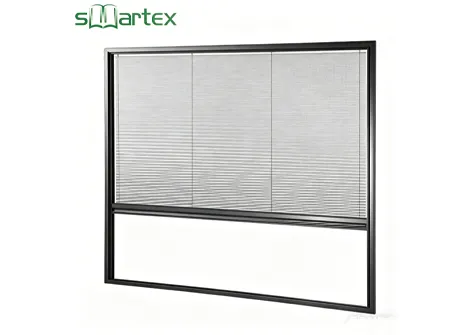
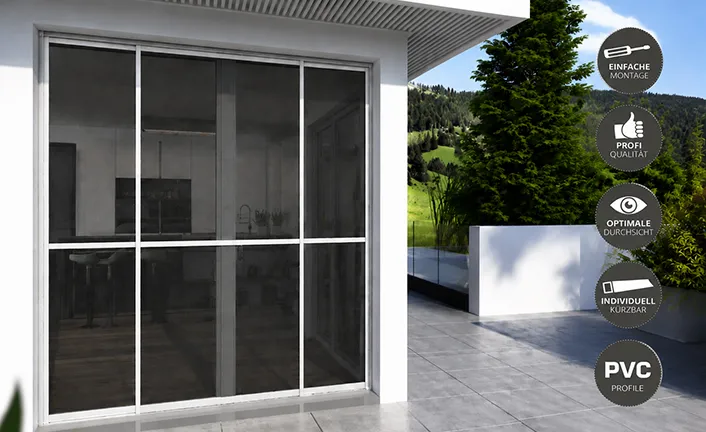
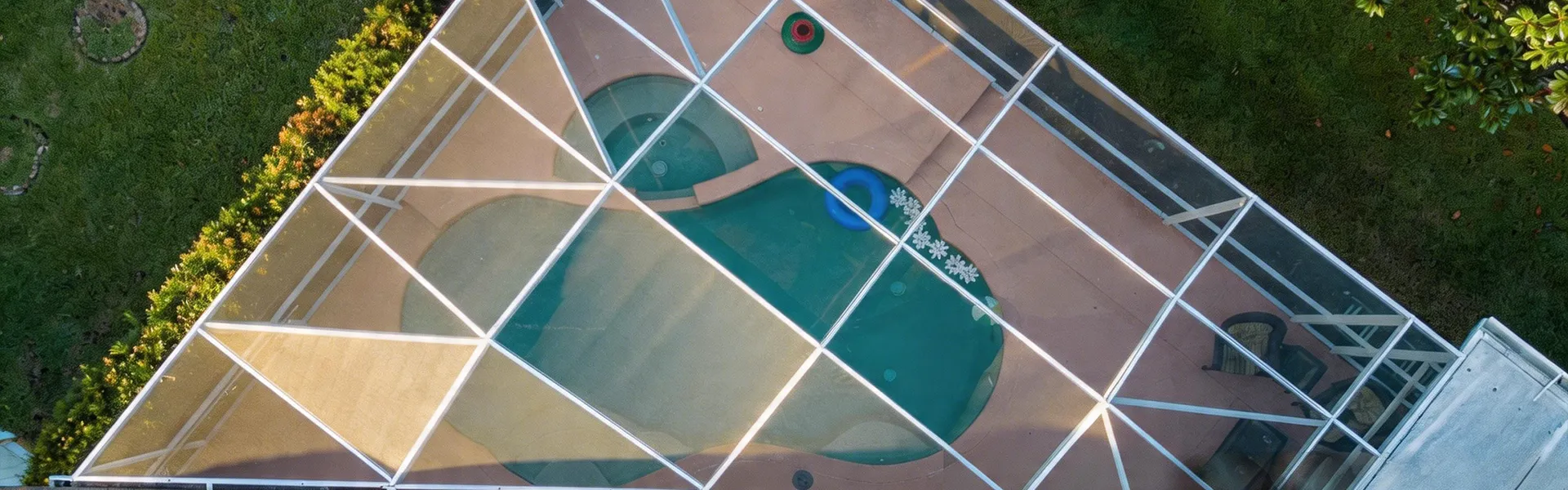
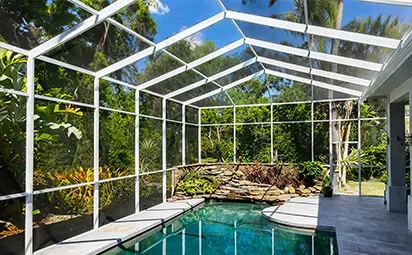
Pool and patio screen mesh is heavy-duty insect screening built for large openings. It is specified by mesh count and fabric weight, most often 17×14, 18×14, 20×17 or 20×20. Published weights in our range run from roughly 133 g/m² to 305 g/m². Mesh count controls which insects are stopped; weight and material control how the fabric survives the opening.
What the two numbers in “17×14” actually control
A mesh count is warp yarns by fill yarns per inch. 17×14 is the traditional count for pool cages and screened porches: openings large enough to keep airflow moving, tight enough for mosquitoes and common flying insects. 18×14 sits close to it and appears in many enclosure programs for the same reason.
Move to 20×20 and the picture changes. The weave is square and denser, which is what makes it a no-see-um fabric: it stops biting midges and gnats that walk straight through a 17×14 opening. The cost of that is airflow and, depending on the yarn and coating, some visibility. 20×17 is the middle position, usually offered in polyester rather than fiberglass.
One misreading comes up often enough to name it: a higher mesh count is not automatically a stronger fabric. Count describes hole density. Strength comes from yarn diameter, material and coating. A 20×20 no-see-um screen with a publicly displayed wire-diameter example of around 0.013 inch and a 17×14 heavy-duty screen can behave very differently under the same wind-blown debris, and neither result can be predicted from the count alone.
Specification table: published model examples
| Model Example |
Mesh Count |
Material |
Published Weight |
Other Published Detail |
| Heavy-duty pool screen |
17×14 |
Fiberglass |
Model-specific |
Traditional enclosure count |
| Enhanced-visibility heavy-duty |
17×14 |
Fiberglass |
~133 g/m² |
Visibility-oriented weave |
| Enhanced-visibility heavy-duty |
20×20 |
Fiberglass |
~176 g/m² |
Denser weave, visibility-oriented |
| No-see-um screen |
20×20 |
Fiberglass |
~215 g/m² |
Wire-diameter example ~0.013 in |
| Heavy-duty screen |
20×20 |
Fiberglass / polyester |
~305 g/m² |
Heaviest published example |
| Heavy-duty polyester screen |
20×17 |
Polyester |
Model-specific |
Polyester construction |
| Pool and patio screen |
18×14 |
Fiberglass |
Model-specific |
Common enclosure count |
| Solar screen fabric |
Shading fabric |
Polyester / vinyl-coated polyester |
Model-specific |
80% and 90% options |
Read this as eight separate products that happen to share a category, not as a range where any value can be mixed with any other. The 305 g/m² figure belongs to one heavy-duty 20×20 construction; it does not describe the 20×20 no-see-um fabric or the enhanced-visibility versions listed above it.
Compared with the pre-cut roll programs common in this product category, where a single 18×14 line is offered in fixed widths and one colour, specifying at model level takes more work upfront. It also means the enclosure gets the fabric it needs rather than the fabric the shelf carried.
Weight, visibility, airflow: pick two
The three properties buyers ask about pull against each other, and no fabric in this category wins all three.
Going denser (20×20) buys insect protection and loses airflow.
Going heavier buys resistance to debris and handling damage, and usually loses light transmission.
Going for enhanced visibility buys a clearer view, and the fabric arrives lighter: the 133 g/m² and 176 g/m² examples above are visibility-first constructions.
Adding solar performance (80% or 90% shading fabric) changes the product’s job from insect screening to shading, with insect control secondary.
For a distributor stocking one enclosure line, the practical answer is usually two SKUs rather than one compromise fabric: a 17×14 or 18×14 fiberglass for general enclosure work, plus a 20×20 no-see-um for coastal and marsh-adjacent regions where the complaint calls come from tiny insects.
Roll width and length are the spec most buyers underspecify
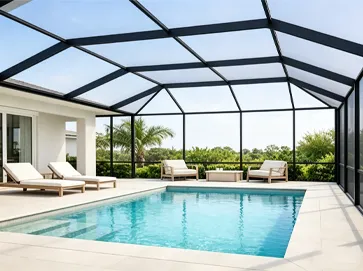
Mesh count gets debated; roll geometry gets assumed. Pool cages are large, continuous openings, and panel width drives both installation labour and waste. Our roll width and roll length are customizable, which is useful and also means the specification is empty until you fill it.
Four items to fix before a quotation is meaningful:
- Finished panel width the fabricator wants to cut from, including trim allowance on both edges.
- Roll length per roll, balanced against what a two-person crew can handle on site.
- Colour: standard charcoal and grey ranges, or a custom RAL or Pantone match.
- Packing format: how rolls are wrapped, cored, palletised and labelled for the destination.
We weave and coat in-house on 120 weaving looms and 16 PVC coating lines, so width and length are set during production rather than by cutting down a stock roll. That is also why the width you specify is the width you are quoted against for the life of the program.
Which certifications apply, and to what
Our website references REACH and RoHS chemical compliance, CE conformity where applicable, UL GREENGUARD Gold certification claims for selected materials, QUV accelerated weathering testing, and Florida Building Code-related references for selected pool-screen applications.
That sentence has to be read carefully, because these references do not all attach to the same thing. A management-system certificate covers the factory. A GREENGUARD Gold claim covers a specific material. A QUV result covers a tested sample under a stated test duration. A Florida Building Code reference relates to an application, and in a code context the approval that matters is usually for the enclosure assembly rather than the fabric on its own.
Before any of these appears in your catalogue, tender or product listing, ask us for the document and check the report title and number, the issuing or testing organization, the tested model and material, the standard version, and the issue and expiry dates. If a supplier cannot produce that document set for the exact model you are buying, treat the claim as unconfirmed. We would rather send you the certificate scope than have a claim travel further than it should.
Ordering: MOQ, samples, lead time
Pricing for screen fabric is quotation-based. It moves with mesh count, material, fabric weight, roll width and length, colour, packing and order quantity, and with shipping terms and destination market. We do not publish a per-square-metre figure, because a 133 g/m² visibility fabric in a standard colour and a 305 g/m² heavy-duty fabric in a custom RAL match are not the same product with a different price tag.
What we can state publicly:
- Screen mesh MOQ: approximately 5,000 m².
- Custom-colour fabric MOQ: approximately 10,000 to 20,000 m², since a colour run has to be scheduled on the coating line.
- Sample fees: approximately USD 50 to 200 for certain products or customized samples. This is a sample policy, not a price indication.
- Standard production lead time: approximately 30 to 45 days, confirmed per order.
- Simple customization: approximately 6 to 8 weeks including the sample-approval loop.
Order a sample of the exact model before the first production run, and hand it to whoever will install it. Enclosure crews notice things a specification sheet does not carry, such as how the fabric behaves under a spline roller and whether it holds a straight edge across a wide panel.
Where this fabric is the wrong choice
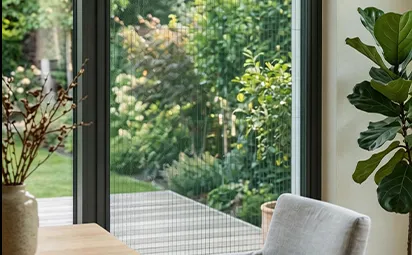
Pool and patio mesh is heavier and more visible than standard window screening, which is exactly why it fails in some places. In a standard residential window frame the heavier constructions are stiff to spline and can look dark from inside. For pet-heavy openings, a vinyl-coated polyester pet-resistant fabric is the better match than a heavy 20×20. For a screened opening where the real complaint is heat and glare rather than insects, an 80% or 90% solar fabric answers the question and a no-see-um mesh does not.
There is also a documentation constraint worth stating plainly. Where a project sits inside a code-driven approval process, fabric-level specifications will not be enough on their own, and the schedule needs to allow for assembly-level documentation from the enclosure system supplier.
FAQ
Q: Which mesh count should I stock for pool enclosures?
A: 17×14 or 18×14 fiberglass covers general enclosure work. Add 20×20 no-see-um for regions where small biting insects drive the complaints. Two counts serve most territories better than one.
Q: Is 20×20 no-see-um mesh stronger than 17×14?
A: Not by definition. 20×20 has a denser weave and blocks smaller insects. Strength depends on yarn diameter, material and coating. Compare weight and construction, and where durability is critical, ask for the test report on that model.
Q: How much does pool and patio screen mesh cost?
A: Quotation-based. Price depends on mesh count, material, weight, roll dimensions, colour, packing, quantity and shipping terms. Send the specification and destination and we will quote against it.
Q: Can I get custom roll widths and colours?
A: Yes. Roll width and length are customizable, and colours can be matched to RAL or Pantone. Custom-colour fabric carries a higher MOQ, approximately 10,000 to 20,000 m².
Q: Does your pool screen meet Florida Building Code?
A: Our website references Florida Building Code-related claims for selected pool-screen applications. Ask us for the document covering the exact model, and check the tested product, standard version and validity date before you rely on it. Code approvals in this area often apply to the enclosure assembly rather than the mesh alone.
Q: What is the minimum order?
A: Approximately 5,000 m² for screen mesh, higher for custom colours. Paid samples of approximately USD 50 to 200 are available first for selected products and customized samples.













 15:39
15:39