Aluminum usually costs more per kilogram of raw material but ships lighter, arrives pre-finished, and bolts together on site. Steel carries more load per section, yet adds freight weight, welding or touch-up labour, and corrosion follow-up. For distributors, the decision usually turns on freight cost, finish system and spare-part supply.
The three points where most pergola comparisons stop
Search “steel vs aluminum pergola” and the results are largely manufacturer blogs that compare rust resistance, weight and maintenance, then land on their own aluminum product. Those three points are not wrong. They are simply written for a homeowner buying one structure.
A distributor buying by the container has a different question list. You are not asking which metal lasts longer in a garden. You are asking what the material does to your landed cost, your warehouse space, your installer’s day rate, and the phone call you get in year four when a louver blade is bent.
Sourcing comparison: steel vs aluminum across eight dimensions
| Dimension |
Steel pergola |
Aluminum pergola |
Why it matters to a distributor |
| Raw-material cost basis |
Lower per kilogram |
Higher per kilogram |
Steel looks cheaper on the material line before finishing and freight are added |
| Density |
Approx. 7.85 kg/dm³ |
Approx. 2.70 kg/dm³ |
Drives freight weight, lifting equipment and installer headcount |
| Section size for equivalent stiffness |
Smaller cross-section |
Larger cross-section |
Aluminum saves weight, not always cube; check which one your freight is billed on |
| Typical shipping format |
Welded or semi-welded frames, often assembled |
Extruded profile bundles, louver blades, hardware cartons |
Flat-pack formats stack; welded frames waste container height |
| Corrosion behaviour |
Requires an applied barrier; exposed steel at cuts and welds corrodes |
Forms a passive oxide layer; galvanic risk at mixed-metal contacts |
Determines warranty exposure in coastal and pool-side installations |
| Finish route |
Galvanizing plus powder coat or paint (duplex) |
Pretreatment plus powder coat, or anodizing |
Two-stage steel finishing adds cost, lead time and colour-matching risk |
| On-site work |
Bolting plus welding, grinding, field touch-up |
Bolting and fastening; adjustment by cutting to length |
Welding on site needs certified labour and site power |
| Spare-part route |
Refabrication of bespoke parts |
Reorder from the same extrusion die |
Decides whether you can hold a small spares stock or must re-source each claim |
Freight: the line item that reverses the price comparison
The density difference between the two metals is roughly a factor of three. That does not translate into a three-times freight saving, because aluminum needs a larger cross-section to reach the same stiffness. The saving lands on weight, and only partially on volume.
Which of those two you care about depends on how your shipment is rated. If your route bills on measurement, a welded steel frame that arrives as a rigid rectangle is the expensive option regardless of what the metal cost, because you are paying for the air inside it. If your route is weight-sensitive, or if inland trucking and last-mile delivery are priced by weight, aluminum starts recovering its material premium immediately.
There is a second, quieter freight effect. Louvered aluminum systems ship as profile bundles plus blade packs plus a hardware carton, which means a damaged post is a damaged post rather than a damaged assembly. Claim rates on flat-packed extrusions tend to be easier to argue with a carrier than claims on a bent welded frame, because the damage is contained to one part number.
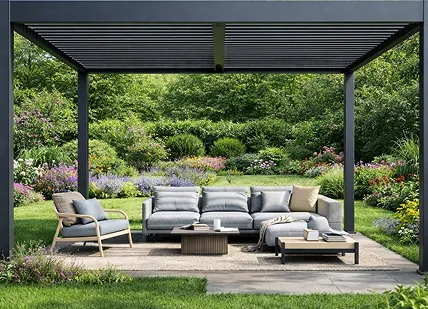
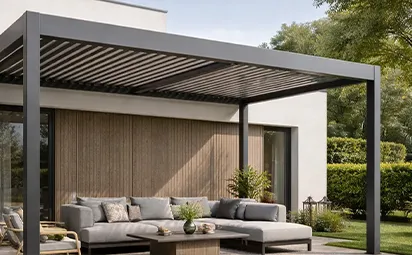
Aluminum Pergola
Finish systems: two very different failure clocks
Steel needs a barrier between the metal and the weather. The common route is hot-dip galvanizing followed by powder coating, sometimes called a duplex system. It performs well until the coating is broken. Every field-drilled hole, every cut end, every on-site weld reopens the substrate, and the repair is a brush-applied touch-up that will not match the factory finish in either colour or life.
Aluminum has no galvanizing step. Pretreatment and powder coating go straight onto the extrusion, and a field cut exposes aluminum that passivates on its own. The failure clock on aluminum is therefore mostly about coating adhesion and colour retention rather than substrate loss.
That shifts what you should ask for in the technical package. Instead of a corrosion warranty in years, ask for the coating test evidence. Our website references QUV accelerated weathering testing for parts of the product portfolio, along with REACH, RoHS and CE-related compliance documents. Those references are not automatically transferable between product lines. Before you put any of them into a tender or a retail claim, confirm the report title and number, the issuing or testing organization, the exact model tested, the standard version, the issue and expiry dates, and whether the document applies to the material, the component or the finished structure. We would rather hand you a scoped answer than a logo.
The same logic applies to process claims. ISO 9001 quality-management and ISO 14001 environmental-management systems describe how a factory runs, not how a specific louver blade performs in a snow region. Use them to judge supplier consistency, not product capability.
Spare parts and the year-four phone call
This is the dimension brand comparisons rarely touch, and it is usually the one that decides whether a pergola line makes money over a five-year cycle.
An extrusion-based aluminum system is defined by its dies. If a customer bends a louver blade or cracks an end cap, the replacement is the same profile from the same die, cut to the same length. You can hold a shallow spares stock of blades, end caps, gutter inserts and fixings, and settle most claims from your own shelf.
A bespoke welded steel structure does not work that way. The replacement part is a fabrication job, which means drawings, a fabricator slot, a finishing cycle and freight for a single item. That is affordable once. It is not affordable as a warranty policy across a few hundred units.
Motorized systems add a layer on both sides. Where a louver system is motor-driven, ask for the motor and gearbox as separately orderable part numbers with the drive interface documented, so a motor failure in year four does not require replacing the roof section it sits in.
Local assembly: what the installer actually does
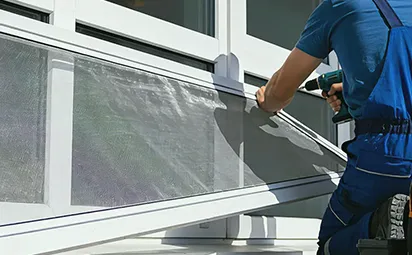
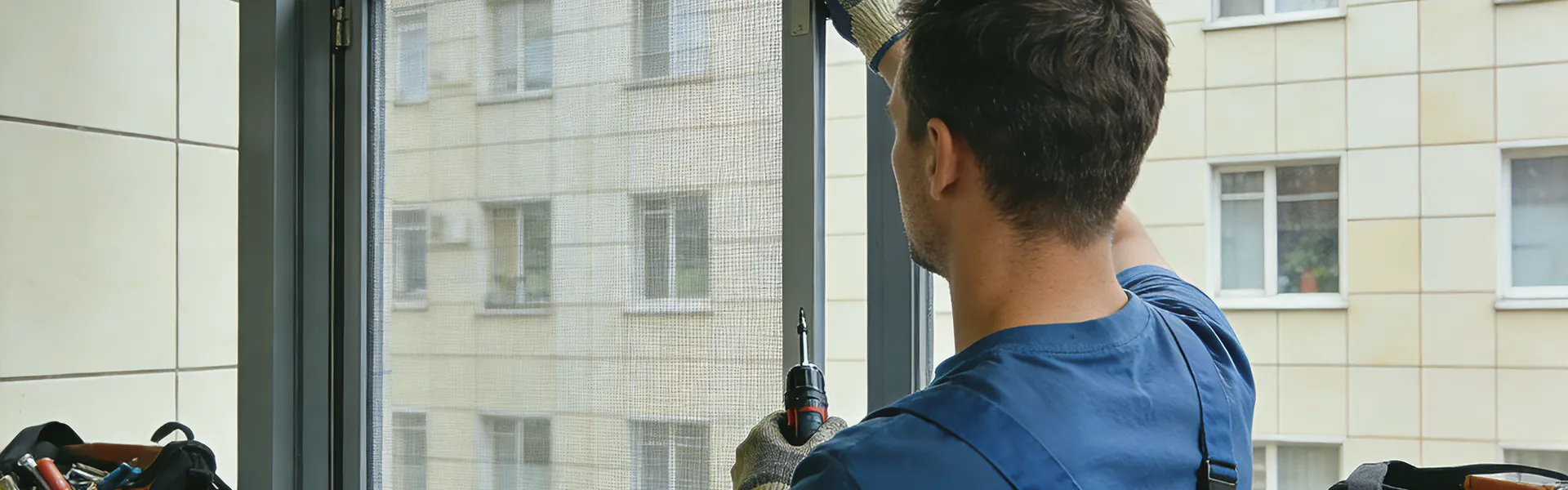
For a bolt-together louvered aluminum system, a typical site sequence looks like this:
- Confirm the fixing substrate and set out post positions against the drawing, checking slab thickness or wall construction before drilling.
- Set and plumb the posts, leaving the anchors accessible for final adjustment.
- Install the perimeter beams and gutter profiles, then check diagonals for square before torqueing.
- Fit the louver blades into the pivot rails and verify that the full open and full closed positions clear the frame.
- Connect the manual crank or the motor drive, then run the louvers through five full cycles under no load.
- Test drainage by flooding the gutter line, then confirm the discharge path away from the fixing points.
- Fit end caps, trims and any side enclosure, and hand over the operating and cleaning instructions.
The steel equivalent inserts welding, grinding, and site painting into the middle of that list, along with heavier lifting for the same span. That changes the installer profile you can sell to. A bolted system can be handed to a general home-improvement fitting crew. A welded system needs a fabricator, site power, and a hot-work method statement, which narrows your installer network and raises the day rate you have to quote against.
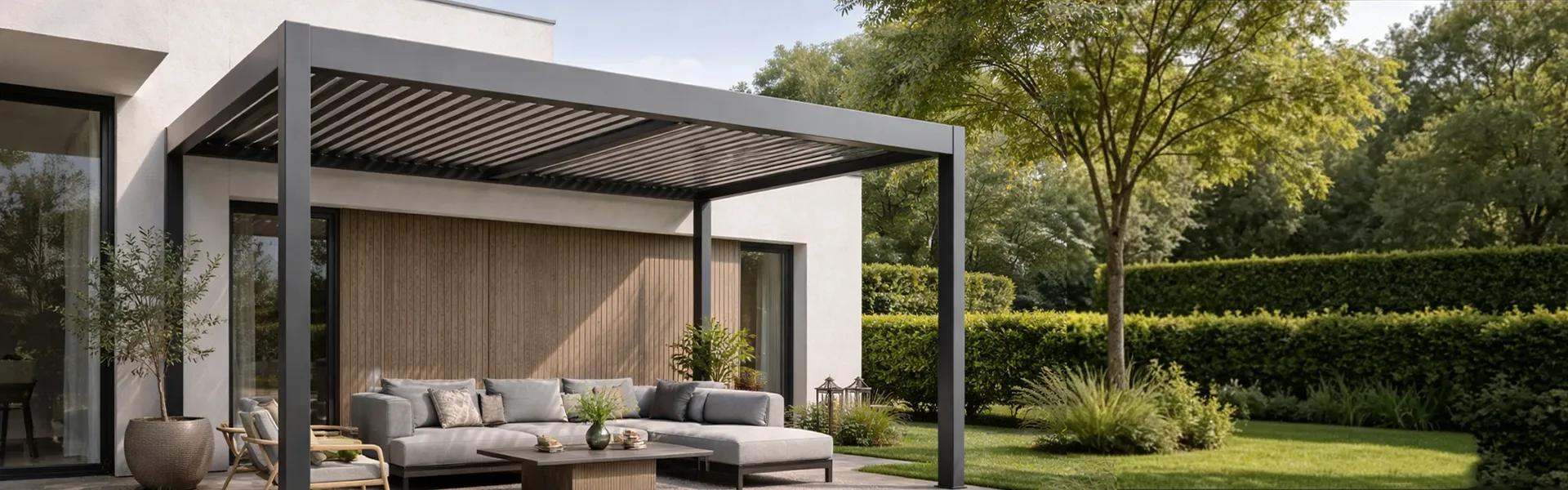
Compared with the fixed-roof patio-cover class that many building-material distributors already stock, such as timber frames with polycarbonate or solid-panel roofing, both metal options trade material cost for adjustability. A louvered roof gives the end user a variable-shade position that a fixed panel cannot, and it opens a second sale in side enclosure.
Three assumptions worth correcting before you quote
“Galvanized steel does not corrode.” Galvanizing protects the surface it covers. Cut ends, field-drilled holes and site welds are not covered. In pool-side and coastal installations, those points are exactly where the first complaints appear, which is why the field-repair procedure belongs in your installation manual rather than in a footnote.
“Aluminum is not strong enough for snow.” Strength is a function of section geometry, wall thickness, louver span and post spacing, not of the metal alone. An aluminum louvered roof designed for a 3-metre bay and one designed for a 5-metre bay are different products even if the extrusion looks similar. The answer has to come from the drawing set for the size you are ordering, not from a material generalization in either direction.
“Stainless fasteners are always the safe upgrade.” Stainless steel in direct contact with aluminum in a salt-laden or chlorinated atmosphere creates a galvanic couple, and the aluminum is the part that gives way. Where that environment applies, the fastener specification and any isolation washers or sleeves need to be confirmed as part of the order rather than left to the installer’s local hardware shop.
What we can confirm about our aluminum louvered pergola
Smartex Screen has manufactured screen and sun-shading products since 2005, and our pergola line is presented publicly with the following scope:
- Structure: aluminum frame with an adjustable louver system
- Installation: freestanding or wall-mounted, depending on the project
- Side enclosure: optional zip blind integration where specified
- Operation: manual or motorized, confirmed per model rather than assumed across the line
- Dimensions: project-specific customization
- Frame colour: customized within the available finish system
- Applications: patios, terraces, hospitality spaces, gardens, commercial outdoor areas and residential outdoor-living projects
What we do not publish, and will not improvise: maximum span, snow load, wind load, drainage rate, motor specification, aluminum wall thickness, surface-treatment standard and structural certification. Those values are project-dependent and are issued with the quotation and drawings. If a supplier gives you a single load figure for an entire pergola catalogue without asking your bay size, treat that figure as marketing rather than engineering.
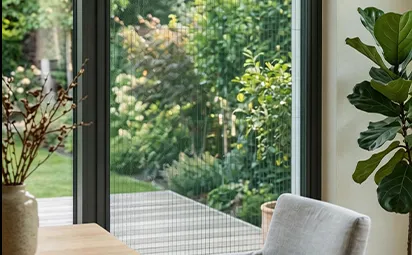
Because our screen-fabric and screen-system production sits in the same operation, the zip blind side enclosure and any insect-screen infill can be specified with the frame instead of sourced separately. For a distributor, that mainly matters at the claims stage, where a single supplier for the frame, the guide rails and the fabric removes the argument about which part failed.
Pricing, MOQ and samples
Pergola pricing is quotation-based. It moves with structure size, louver configuration, fixing type, operation (manual or motorized), finish colour, optional zip blind integration, packaging format, order quantity, destination market and shipping terms. We do not publish a per-unit price range, because a freestanding 3 × 4 m manual unit and a wall-mounted motorized run with side screens are not the same product.
On minimum quantities, the figures we present publicly cover the screen side of the business: approximately 5,000 m² for screen mesh, approximately 500–1,000 sets for finished kits, and approximately 10,000–20,000 m² for custom-colour fabric. Pergola minimums are project-based and confirmed per enquiry. Our published sample-fee reference of approximately USD 50–200 applies to certain products and customized samples; it is a sample policy, not a unit price, and full-size pergola samples are handled as a separate commercial discussion.
A checklist before the order goes in
- Ask for the drawing set for your actual bay size, not the catalogue photo.
- Get the fastener and isolation specification in writing if the site is coastal, chlorinated or pool-adjacent.
- Request the spare-part list with part numbers for blades, end caps, gutter components, crank or motor, and fixings.
- Confirm the packing format and the cube per unit before you model landed cost, then check whether your route bills on weight or measurement.
- Ask which finish tests exist, for which model, and whether the report covers the finished structure or only the coating material.
- Confirm the colour-approval process for any custom RAL or Pantone request, including how extruded parts and cast or sheet parts will be matched.
- Agree the field-repair procedure for coating damage, and have it written into the installation manual you ship to your customers.
Two items sit outside the material comparison and still need work before a first shipment: destination-market structural approval, which in some regions requires local engineering sign-off regardless of what the factory drawings say, and the electrical compliance route for motorized units, where the applicable marking depends on the market and the motor supplier rather than on the frame. Both are worth resolving during sampling, not after the container is booked.
FAQ
Q: Is an aluminum pergola always cheaper to import than a steel one?
A: Not on the material line. Aluminum usually costs more per kilogram. It becomes competitive once finishing, freight, lifting equipment and installation labour are included, and the size of that swing depends on whether your freight is rated by weight or by measurement.
Q: Which material handles a pool-side or coastal installation better?
A: Aluminum, in most cases, because it does not depend on an intact barrier coating to resist corrosion. The condition is that fasteners and any contact points with other metals are specified for that environment, otherwise galvanic corrosion moves the problem onto the aluminum.
Q: Can a steel pergola span further than an aluminum one?
A: For the same cross-section, yes. For the same delivered structure, the honest answer is that span is set by the engineering of the specific system, so the comparison has to be made between two drawing sets rather than between two metals.
Q: What load ratings can Smartex Screen provide for its louvered pergolas?
A: Span, wind and snow values are issued with the quotation and drawings for the configuration you order. We do not publish a single catalogue-wide figure, because bay size, post spacing and louver length change the result.
Q: Do the certifications referenced on your site apply to the pergola line?
A: Not automatically. The references we publish, including ISO 9001, ISO 14001, REACH, RoHS, CE and QUV weathering testing, apply to specific companies, materials, models or systems. We confirm the exact document scope per product before it is used in any tender or retail claim.
Q: How should a distributor stock spare parts for a louvered pergola line?
A: Start with the parts that fail from handling rather than from weather: louver blades, end caps, gutter inserts and fixings. Ask for these as individual part numbers at order stage, and keep the motor or crank on a re-order basis rather than in stock unless your installed volume justifies it.
















 13:48
13:48