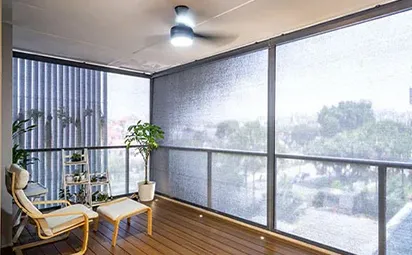
An store banne extérieure à fermeture éclair est généralement tout au plus résistante à l’eau, et non étanche. Les tissus en maille et les toiles ajourées laissent passer l’eau par conception, et même les tissus pleins peuvent laisser entrer l’eau au niveau du coffre, de la barre inférieure et des coutures. Un rail à fermeture éclair ferme les espaces latéraux, ce qui réduit la pluie sur les bords, mais ne transforme pas le système en paroi étanche.
Étanche à l’eau ou résistante à l’eau : deux promesses différentes
Imperméable décrit une barrière qui empêche l’eau liquide de passer dans les conditions indiquées. Pour une store banne extérieure, cette promesse devrait couvrir l’ensemble du système installé : tissu, coutures, guides latéraux, cassette supérieure, barre inférieure et espace entre la barre et le sol.
Résistante à l’eau (parfois appelé “ déperlant ”) signifie que le matériau ralentit l’eau ou la fait glisser à sa surface. Une pluie légère forme des gouttelettes qui ruissellent. Une pluie persistante, de l’eau stagnante ou la pression du vent finit par traverser le matériau.
Une troisième catégorie est souvent absente de la discussion : les tissus perméables à l’eau. La plupart des tissus de stores zip de type screen appartiennent à cette catégorie. Leur tissage ajouré est conçu pour laisser passer l’air et la lumière, et laisse donc aussi passer l’eau. Ils peuvent néanmoins réduire la quantité de pluie qui atteint un espace de détente, car une partie des projections frappe les fils et ruisselle sur la face du tissu. C’est un avantage utile. Il ne s’agit pas d’une résistance au sens textile du terme, et encore moins d’une imperméabilisation.

Par où l’eau passe-t-elle au-delà d’un store zip ?
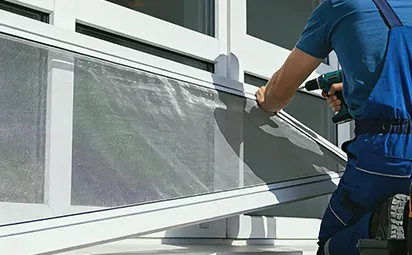
Un store zip est un panneau en tissu dont les bords latéraux coulissent à l’intérieur de coulisses, empêchant ainsi le tissu de battre au vent ou de sortir du rail. Contrairement aux stores en PVC enroulables, qui pendent librement ou sont maintenus par des sangles et des crochets, il ferme les espaces latéraux ouverts par lesquels la pluie poussée par le vent pénètre généralement en premier. De nombreuses pages de revendeurs s’arrêtent là dans leur explication.
Le problème, c’est que les côtés ne sont que l’un des nombreux passages possibles :
- Through the fabric itself. On any open-weave fabric, this is the main path.
- Over the top. Water running down a wall or off a roof edge can track behind the cassette and down the inside face of the fabric unless the installation includes flashing or a roof overhang.
- Under the bottom bar. Patios, decks and balcony tiles are rarely perfectly level. Any gap between bar and floor lets water and wind-blown spray through, and floor drainage can push water inward.
- At fabric joins. Wide openings sometimes need fabric panels welded or stitched together. Stitch holes are a classic leak point on otherwise solid fabric.
- Through the guide channels. Channels keep the edge captured; they are not gaskets. Water running down the outside of a channel can still reach the inside.
So the honest answer depends on the whole assembly, and the fabric decides most of it.

Fabric Type Decides Most of the Result
The table below compares the common categories of fabric used in outdoor screens and blinds across the industry. It describes how each category behaves in rain in general terms. It is not a Smartex Screen specification, and which of these we can supply for a particular zip blind model must be confirmed for that model.
| Fabric category |
Structure |
Rain behavior |
Airflow and view |
Typical trade-off |
| Open-weave coated polyester screen fabric |
Coated yarns woven with visible openings |
Water passes through the openings; some spray is deflected |
Air moves through; outward view retained |
Comfortable in heat, but the space behind it will get wet in steady rain |
| Tighter-weave screen fabric |
Same principle, smaller openings |
Less spray gets through, but water still passes |
Less airflow, darker view |
A middle path that still cannot be called water-resistant without a test |
| Coated solid (non-mesh) fabric |
Base cloth with a continuous coating |
Resists water through the cloth; seams and edges remain weak points |
No airflow; no view unless printed or sheer |
Traps heat and humidity; carries higher wind load on the panel |
| Clear PVC sheet |
Continuous transparent film |
Blocks water through the material |
No airflow; full view |
Condensation on the inside; can scratch and needs careful cleaning |
Two practical points follow from this. A blind that blocks water also blocks air, so a fully closed patio can feel stuffy and damp in warm weather. And a solid panel catches more wind than a mesh panel, which matters for how the system is sized and when it should be retracted.

The “PVC Means Waterproof” Mistake
This is the most common error we see in sourcing briefs and on marketplace listings. “PVC” appears in two very different products:
- PVC-coated polyester screen fabric, where each yarn is coated and then woven into an open mesh. Smartex Screen produces PVC-coated fabrics on its own coating lines, and in mesh form the openings are still there. Water goes through them.
- PVC sheet or film, a continuous layer with no openings.
A listing that says “PVC zip blind, waterproof” without saying which of these it is will mislead the end customer. When the customer sits behind a PVC mesh blind in a downpour and gets wet, the complaint lands on the seller, not the factory.
Edge cases worth planning for
- Retracting a wet blind. Rolling up damp fabric and leaving it in the cassette for days invites mildew and staining. Let it dry extended where possible.
- Water pooling at the bottom bar. On a solid fabric, wind can push the panel into a belly where water collects. Check how the bottom bar and floor detail are drained.
- Motorized systems in wet weather. Whether a motor, wiring and controls are rated for exposed, wet conditions is a model-specific question. Confirm it from the motor specification for the exact system rather than assuming it.
- Using zip blinds as a roof. Zip blinds are vertical side enclosures. On a pergola, rain protection overhead comes from the roof system; the zip blind only closes the sides.
Smartex Screen Zip Blind Parameters
The figures below reflect what Smartex Screen currently presents for its zip blind and zip screen range.
| Paramètre |
What we present |
Notes for buyers |
| Product types |
Zip blind, zipscreen, zip track blind, outdoor zip screen blind, patio, balcony and pergola zip screens |
Choose by opening type and project |
| Manœuvre |
Motorized or manual, depending on model |
Motor details confirmed per model |
| Toile |
Toile d'ombrage extérieure spécifique au produit |
Water behavior must be confirmed for the selected fabric |
| Dimensions |
Sur mesure, adaptée à l'ouverture et au projet |
Measure finished openings, not nominal sizes |
| Couleur de la toile |
Standard ou sur mesure |
Custom colors may affect MOQ and lead time |
| Couleur du cadre et des coulisses |
Standard ou sur mesure |
Match to window or pergola finish |
| Emplacements d'installation |
Fenêtres, patios, balcons, pergolas, fermetures extérieures, ouvertures de projet |
Pergola integration available where specified |
| Functions we present |
Protection solaire, réduction de l'éblouissement, intimité, protection contre les insectes, gestion du vent |
Waterproofing is not among the listed functions |
For durability, the Smartex Screen references QUV accelerated weathering testing for selected products. If outdoor UV and moisture exposure are part of your market’s buying criteria, ask for the QUV report covering the exact fabric you are ordering. A report for a different material does not transfer.
Which Words Can Go on Your Product Listing?
This is where most of the risk sits for distributors and e-commerce sellers. The safest approach is to describe what the product does, in terms your supplier’s documents can support.
| Wording |
Recommendation |
Why |
| “Waterproof”, “100% rainproof”, “storm-proof” |
Avoid |
The installed system has leak paths beyond the fabric; absolute claims invite returns and complaints |
| “Completely windproof” |
Avoid |
A zip track helps keep fabric in the guides; that is wind-management support, not wind-proofing |
| “Water-resistant fabric” |
Use only with a test report for that fabric |
Needs evidence specific to the material and model |
| “Helps reduce rain at the side edges” |
Acceptable with explanation |
Describes the zip-track function without promising a dry space |
| “Shading”, “glare reduction”, “privacy”, “insect control” |
Safe to use |
Matches the functions Smartex Screen presents for the range |
| “Wind-management support” |
Safe, with a note to retract in strong wind if the model calls for it |
Matches presented functions; avoid implying a wind rating |
Your marketplace and destination market may also have their own rules on product claims.
What Zip Blinds Do Well in Wet Weather, and Where They Fall Short
Strengths
- Side edges stay captured in the guides, so the fabric does not flap and slap in gusty weather.
- Closing side gaps cuts the amount of wind-driven spray entering at the edges, compared with free-hanging shades.
- Mesh versions keep airflow, so a covered patio stays usable in warm, showery conditions.
- One system covers shading, privacy and insect control, which simplifies a product line for retailers.
Limits that should affect the purchase decision
- A mesh zip blind will not keep a seating area dry during steady rain. If end customers expect that, a mesh product is the wrong recommendation.
- Solid, water-resistant fabrics remove the airflow advantage and can make an enclosed space humid.
- Floor level and drainage at the bottom bar are installation issues the factory cannot fix.
- Performance claims beyond the presented functions need model-specific documents, which takes time to collect before launch.
How to Brief a Supplier on Water Performance
If you are adding zip blinds to a range and water performance matters in your market, put these steps into your sourcing brief:
- State the end use. “Shade and insect control on a covered patio” leads to a different fabric than “keep spray off outdoor furniture on an exposed balcony”.
- Ask which fabric category the quoted model uses. Mesh, tighter-weave screen, coated solid or clear sheet. Get the answer in writing.
- Request documents for that exact fabric. Any weathering report (such as QUV), plus any water-related test the supplier holds. Check the tested model matches the one quoted.
- Confirm seam method on wide panels. Ask whether wide openings require joined fabric and how the join is made.
- Clarify motorized versus manual. For motorized systems, ask for the motor specification relevant to outdoor exposure.
- Order samples before listing copy is written. Smartex Screen offers paid samples for certain products; sample fees are a sampling cost, not the product pri
- Write listing wording from the documents you received. If a claim is not backed by a document, leave it out.
On cost: zip blind pricing is quotation-based. It depends on size, fabric, operation type, frame and guide color, packaging, customization, order quantity and shipping terms. For general planning, our standard production lead time is approximately 30–45 days, though the actual schedule depends on the product, materials, packaging and sample approval.
To learn more about the product information, please contact us.
FAQ
Are outdoor zip blinds waterproof?
Generally no. Mesh fabrics let water through, and even solid fabrics can leak at seams, the top cassette and the bottom bar. Smartex Screen does not present its zip blinds as waterproof; the presented functions are shading, glare reduction, privacy, insect control and wind-management support.
Does the zip track make the blind water-resistant?
The zip track holds the fabric edge inside the side guides, which closes the side gaps and reduces wind-driven rain at the edges. It does not stop water passing through the fabric or under the bottom bar.
Is PVC-coated mesh the same as a PVC rain screen?
No. PVC-coated polyester mesh has coated yarns with open spaces between them, so water passes through. A PVC sheet is a continuous film that blocks water but also blocks air.
Can I leave a zip blind down in the rain?
Usually yes for rain itself, but follow the guidance for the specific model, especially in strong wind. Let the fabric dry before rolling it up for long periods to reduce the risk of mildew.




















 09:03
