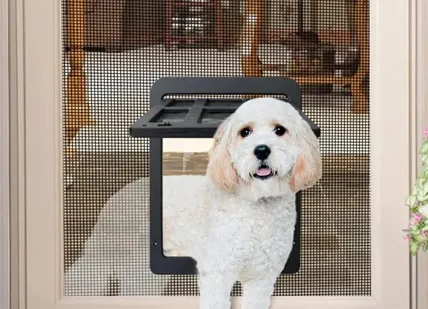
Replacing a window screen comes down to matching the new mesh to the frame it goes into, then fitting it under even tension. Pick the mesh by use (standard fiberglass, pet-resistant, or high-visibility), measure the frame rather than the opening, and test-fit a sample before any volume order.
Which screen are you actually replacing?
The method below applies to framed screens that hold flat mesh in a groove. Our window-screen range also covers sliding, retractable, roller, pleated, magnetic, fixed, extendable and roof-window types, and several of these do not rescreen this way.
Pleated screens are the clearest exception. Pleat shape and stiffness are made to suit the specific screen system, and the pleat heights we display publicly (about 15 mm and 20 mm) are tied to that system. Flat mesh is not a substitute. Roller and retractable screens use mesh specified for the system, so replacement follows that system’s own instructions.
Match the mesh to the job: five options
| Mesh Type |
Material |
Typical Use |
What to Confirm Before Ordering |
| Standard Fiberglass Insect Screen |
Fiberglass yarn with product-specific coating; custom weight options roughly 80–140 g/m² depending on product |
Fixed, roller and retractable screens, DIY kits |
Mesh count, yarn diameter, weight, roll size |
| Stiff Fiberglass / Roller Mesh |
Fiberglass; one stiff product is listed at 0.28 mm |
Roller and retractable systems |
The 0.28 mm figure applies to that product only |
| High-Visibility Screen |
Fiberglass or polyester, by model |
Markets where view-through matters |
Visibility and airflow values for the exact model |
| Pet-Resistant Screen |
Polyester, PET, vinyl-coated polyester or model-specific material |
Pet-friendly and high-traffic windows and doors |
Strength level and test report for that model |
| Pleated Mesh |
PVC-coated polyester, PET, polyester, PP or PE |
Pleated systems only |
Pleat height, stiffness, system fit |
Mesh count alone does not define a mesh. Yarn diameter, weight and coating all change how it looks and fits, which is why we ask buyers to confirm these on the selected product rather than infer them from a category.
Strength, visibility and airflow are set per model, and a change in one can move the others. Compare the two datasheets side by side instead of assuming a pet-resistant mesh looks and breathes like the fiberglass it replaces. We do not publish a numerical strength multiplier for pet-resistant mesh; ask for the test report on the exact model.
Replacement parts we supply, and what varies by model
| Item |
Catalog Parameters |
Confirm Per Model |
| Replacement Screen Mesh |
Roll width and length customizable; standard colors plus custom RAL or Pantone matching |
Mesh count, weight, coating, packaging |
| Window Screen Frame |
Aluminum, plastic or composite components by model; standard and custom sizes; standard and custom frame colors |
Profile, corner method, groove design |
| DIY Window Screen Kit |
Kit-based installation; bulk, retail-ready, e-commerce, DIY-kit or private-label packaging; barcodes and multi-language manuals available |
Kit contents, standard sizes, warranty |
| Screen Repair Tape |
Listed in the window-screen range |
Specification to be confirmed |
One magnetic framed window-screen model is presented with a 6 mm profile, roughly 15-minute installation and nine standard sizes. Those values belong to that model and should not be quoted for other frames or kits.
Re-fitting the mesh: eight steps
These steps assume a frame where a spline presses the mesh into a groove. If your frame uses another retention method, follow that model’s instructions.
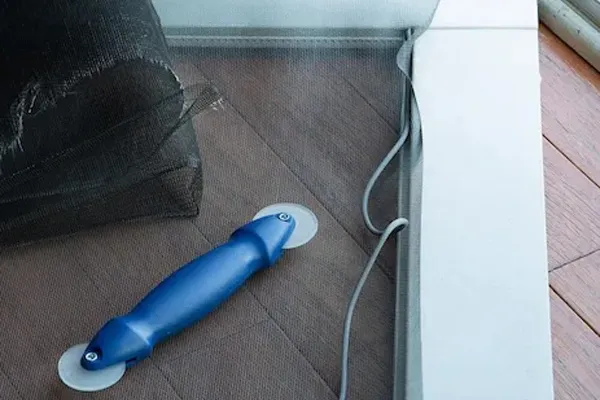
- Strip the old mesh. Lay the frame flat, pull the spline out of the groove and remove the mesh. Check: the bare frame lies flat and both diagonals measure the same. A racked or bowed frame will not hold new mesh flat.
- Measure the frame. not the window opening. Record the frame’s outer length and width and note the groove path. Check: every dimension you write down was taken from the frame itself.
- Cut the mesh. Cut a piece larger than the frame on every side, with the weave lines running parallel to the frame edges. Check: a straight edge laid along one yarn line sits parallel to the frame edge.
- Seat the first side. Lay the mesh over the groove and press mesh and spline into it along one long side. The spline must suit the groove, and if the new mesh is thicker than the old one, test a corner first. Check: the spline sits flush and the mesh has not pulled out at the corner.
- Work across. Pull the mesh gently toward the opposite long side and seat it, then do the short sides. Check: no diagonal wrinkles run from the corners. If they do, lift the spline on that side and re-seat.
- Trim. Cut the excess along the outer edge of the spline with a sharp blade angled away from the mesh. Check: no loose yarn ends remain outside the groove.
- Test the tension. Press the center of the mesh with a flat palm. Check: it returns flat and the frame stays square. Over-stretched mesh pulls the frame edges inward, and slack mesh flutters in a breeze.
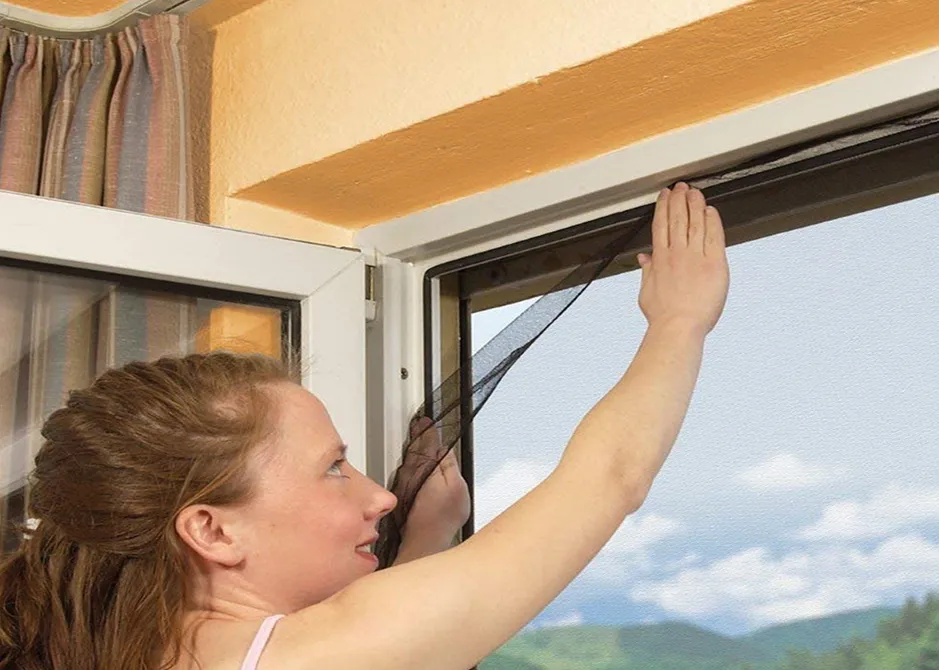
- Refit and inspect. Put the screen back in the window and look along all four edges. Check: no visible gaps between screen and window frame.
Roll mesh, kits or finished screens: sourcing routes compared
| Route |
What the Buyer Receives |
MOQ Example from Our Published Guidance |
Trade-Off |
| Roll Mesh |
Rolls cut to your width and length, standard or custom color |
About 5,000 m² (custom-color fabric: about 10,000–20,000 m²) |
End users need to know their frame and spline before buying |
| DIY Rescreening Kit |
Kit-based product in retail-ready, e-commerce or DIY packaging, with barcodes and manuals |
About 500–1,000 sets |
Each frame size or kit variant becomes its own SKU |
| Finished Framed Window Screen |
Assembled screen in standard or custom dimensions |
Finished-kit example applies; confirm per model |
Sizing has to be right at order, since a wrong size means a new unit |
MOQ figures are examples and change with material, model, color, packaging and customization level.
Compared with buying mesh from one supplier and frames or kit parts from another, taking both from one manufacturer gives you a single specification to check for mesh-and-frame compatibility. We weave and coat the fabric and also assemble finished screens, so a mesh change can be tested against the frame before the order is placed. The limit is that a mesh or frame outside our catalog needs development time. Our published guidance is roughly 6–8 weeks for simple customization and 10–14 weeks for moderate product development.
Where replacements go wrong
- Ordering by mesh count only. Two meshes with the same count can differ in yarn, weight and coating, and so in fit and appearance.
- Putting pet-resistant mesh into a frame built for fiberglass. Polyester, PET and vinyl-coated meshes behave differently under tension. Test-fit a sample in the actual frame.
- Rescreening a pleated screen with flat mesh. The pleats are part of the system, so the mesh has to come from the same pleated specification.
- Assuming a color match. Custom RAL or Pantone colors are possible, but the custom-color MOQ example is far higher than the standard-color one.
- Copying one model’s data onto another. The 6 mm profile above is a single model’s figure.
Pricing, MOQ, lead time and compliance documents
Pricing is quotation-based. It depends on mesh type, mesh count, weight, roll or frame size, components, color, packaging, customization level, mold requirements, order quantity, shipping terms and destination market. We do not publish a price range for these products.
Samples are a separate policy: our FAQ refers to paid sample fees of about USD 50–200 for certain products or customized samples, which is not a selling price. Standard production lead time is about 30–45 days, and this is general guidance to be confirmed against your product, quantity and sample approval.
For EU-bound orders, ask for documents covering EU REACH and RoHS requirements for the exact mesh model. We reference REACH, RoHS and CE compliance documents for parts of our portfolio, but the scope differs by document. Check the tested model, the issuing body, the issue date and whether the document covers the material, the component or the finished screen.
Before you request samples
Send the following so the sample matches your program:
- A photo or drawing of the frame profile, including the groove.
- The frame’s outer dimensions.
- The current mesh type, or a swatch.
- Target markets, which decide the documents you will need.
- Intended pack format: bulk roll, retail-ready pack, e-commerce or private label.
- Whether you need a custom color, and its RAL or Pantone reference.
FAQ
Can I replace fiberglass mesh with pet-resistant mesh in the same frame?
Sometimes, but the two materials differ, so test-fit a sample in the actual frame first. Confirm the mesh thickness against the groove and spline before ordering volume.
How wide should the roll be?
Measure the frame’s longest side and add a margin for gripping the mesh during fitting. Roll width and length are customizable, so it can be set to your frame sizes.
Can pleated or roller screens be rescreened with flat mesh?
No. Pleated mesh is made to suit the pleat shape and stiffness of its system, and roller screens use mesh specified for that system.
What are the MOQs for replacement mesh and kits?
Published examples are about 5,000 m² for screen mesh, about 500–1,000 sets for finished kits and about 10,000–20,000 m² for custom-color fabric. The exact MOQ depends on the model, material, color and packaging.
Can you match the color of an existing frame or mesh?
We offer standard colors and custom RAL or Pantone matching. Send a reference and the target quantity.

















 09:13
09:13