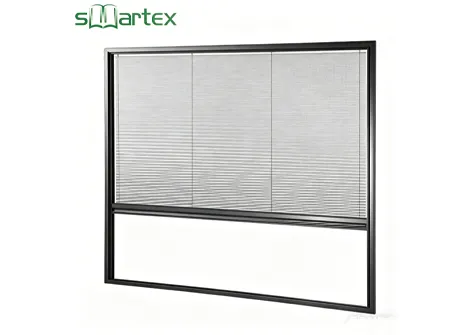
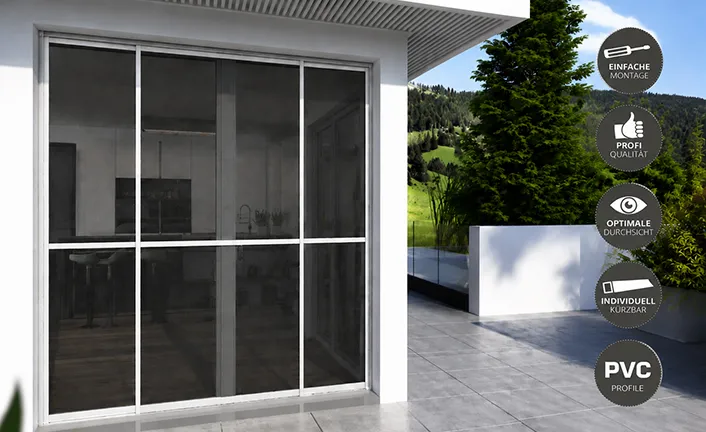
A good screen door should keep insects outside without making a doorway hard to use. But magnetic curtains, hinged frames, sliding systems, and retractable designs work very differently. This guide explains how each screen type works, where it fits best, and what buyers should compare before ordering.
For building material distributors, window and door suppliers, DIY retailers, hardware importers, and private-label brands, choosing the right product is about more than price. You also need to consider the door frame, installation method, material, packaging, durability, and how the customer will use the doorway every day.
What Type of Screen Door Is Best for Different Door Openings?
There is no single bestscreen door for every building. The correct choice starts with the size and movement of the existing door.
A simple single door may work well with a magnetic curtain or hinged aluminum frame. A large sliding dooroften needs a sliding or side-retracting system. A wide French door may need a double pleated or double retractable design.
The main door screen options include:
| Product Type |
Best Application |
Main Advantage |
| Magnetic Curtain |
Apartments, kitchens, and rental homes |
Fast DIY installation |
| Hinged Aluminum Frame |
Front and back doors |
Stable, long-term structure |
| Sliding Screen |
Sliding patio openings |
Smooth horizontal movement |
| Pleated Screen |
Wide openings and modern homes |
Compact folding design |
| Retractable System |
Premium residential doors |
Hidden when not in use |
| Strip Mosquito Curtain |
Budget DIY market |
Low-cost insect protection |
The door opening should always be measured before choosing a product. Buyers also need to check handles, hinges, thresholds, wall clearance, and whether the system mounts inside or outside the existing frame.
A product that looks ideal in a catalog can fail if it does not fit your opening correctly.
When Should You Choose a Retractable Screen Door?
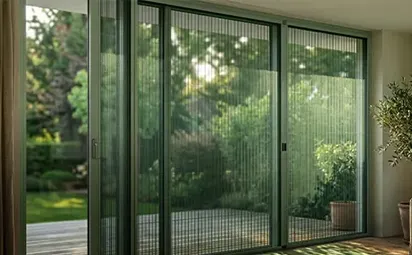
A retractable screen door stores the screening material inside an aluminum cassette when it is not being used. The user pulls the material across the doorway and locks it in position. When opened, the material returns into the cassette.
This type of retractable screen is especially useful where homeowners want the doorway to stay visually open when insect protection is not needed.
It works well for:
- French doors
- Patio entrances
- Balcony openings
- Large exterior openings
- Premium residential projects
- Window and door system dealers
A single retractable unit can serve one side of an opening, while a double system can meet in the middle of a wider doorway.
For B2B buyers, a retractable system is usually more complex than a magnetic curtain. You need to compare the cassette, spring or rolling mechanism, guide rails, locking parts, brush seals, and screen material.
The product should move smoothly without excessive force. The tracks should remain aligned. The netting should also return neatly without folding or dragging.
A properly designed retractable product combines insect control with a cleaner architectural appearance.
Is a Sliding Screen Door Better for a Patio Door?
A sliding screen door is often a practical choice for a patio door or other large horizontal opening.
Instead of swinging inward or outward, the **sliding screen** moves along a track. This saves space and works naturally beside a sliding glass door.
A typical system may use:
- Aluminum profiles
- Rollers
- Corner connectors
- Handle and latch
- Replaceable screening material
- Top and bottom tracks
Some buyers specifically look for aluminum sliding screen doors because aluminum gives the frame a rigid structure without making it excessively heavy.
For a sliding patio opening, pay close attention to track dimensions. Even a few millimeters of difference can affect movement.
A good sliding door screen should move smoothly but should not feel loose inside the rail. The corners need enough strength to keep the frame square over time.
Retail markets also commonly use size descriptions such as 32-in, 36-in, or 96-in, depending on the product and opening. These numbers should only be used when they match the actual model. Never assume one standard size fits every market.
For distributors, custom sizing can often reduce returns compared with forcing buyers to choose from a limited set of standard dimensions.

Magnetic Screen Doors or Hinged Screen Doors: Which Is Better?
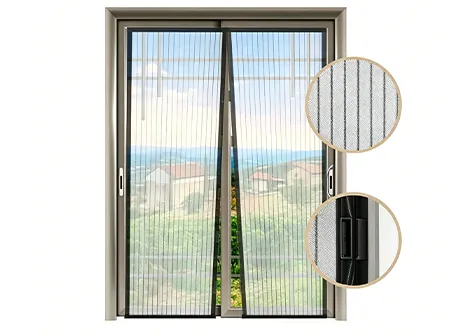
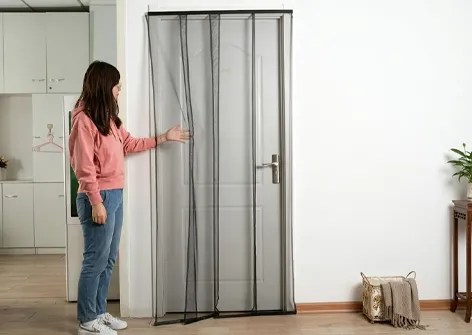
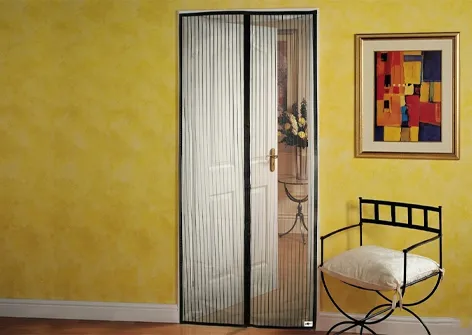
Magnetic screen doors are among the easiest products for DIY retail.
They usually use a flexible polyester screen magnets along the center opening, and hook-and-loop fixing around the doorway. A person walks through the center, and the magnets pull the two panels together again.
This type is especially attractive for:
- Rental homes
- Kitchens
- Apartments
- Families with pets
- Seasonal insect control
- Supermarkets
- Amazon and e-commerce sellers
The main benefit is simple installation. Many versions are easy to install and require little or no drilling.
A hinged screen door however, acts more like a traditional door.
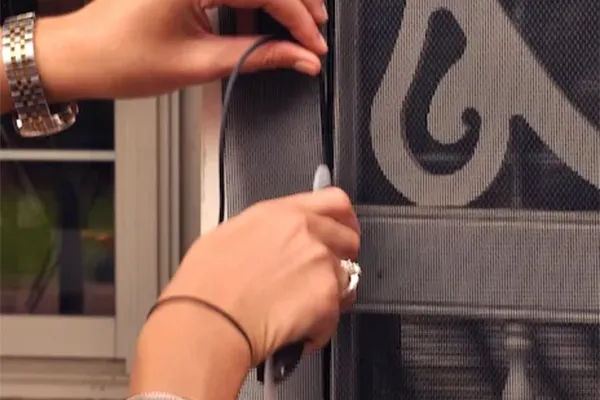
A rigid aluminum frame attaches with a hinge, and the whole panel swings open. A spring hinge or magnetic catch may help it close after use.
A hinged screen system usually feels more permanent. A well-made hinged screen door can also use replaceable netting, stronger corners, handles, kick plates, and customized frame colors.
Choose magnetic products when low cost and easy DIY installation matter most.
Choose a framed hinged product when the customer wants a more permanent doorway solution.
What Makes a Heavy Duty Screen Door More Durable?
The phrase heavy duty screen door should refer to the whole structure, not just thicker screening material.
A strong product needs several parts to work together:
- Rigid frame profiles
- Secure corner joints
- Reliable fasteners
- Strong handles
- Stable hinges or rollers
- Suitable netting
- Proper edge retention
- Accurate assembly
A heavy-duty material inside a weak frame will not create a strong door.
The same principle applies to a so-called heavy duty durable door. Buyers should ask how the frame is constructed, how the corners are joined, and how the material attaches to the profile.
An aluminum system made from extruded aluminum may provide better rigidity than a very thin flexible frame, but wall thickness and profile design still matter.
Material selection is also important.
Standard fiberglass works well for many residential applications. Fiberglass mesh is flexible, economical, and easy to fabricate.
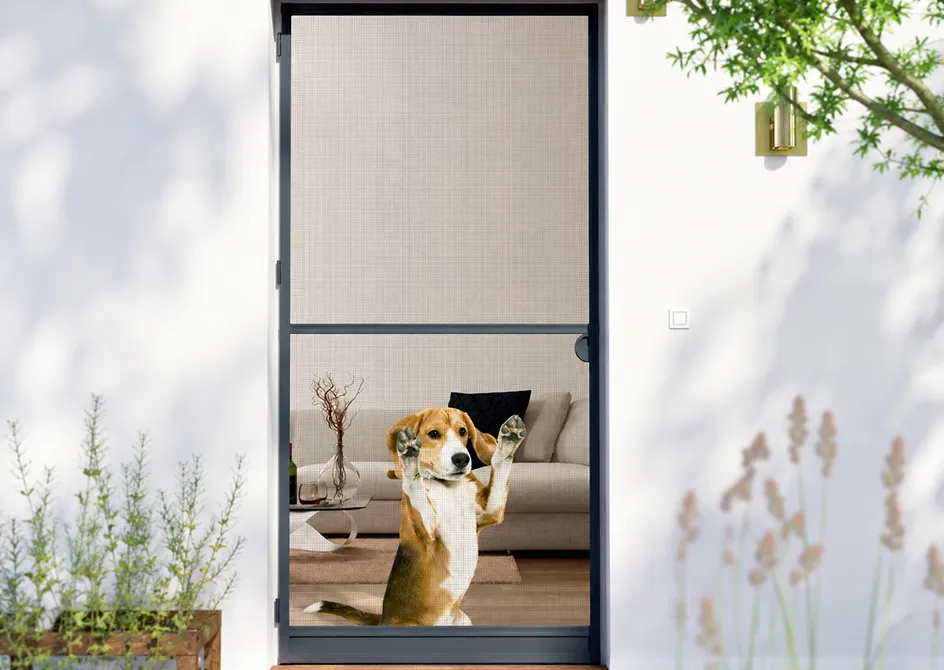
A stronger pet screen may use thicker polyester or another reinforced material where claws or frequent contact are expected.
A durable mesh can help improve service life, but it should not be marketed as indestructible.
Durability depends on:
- Frequency of opening
- UV exposure
- Pets
- Children
- Wind
- Installation quality
- Frame alignment
- Cleaning
- Local climate
A product is truly built to last only when each component suits the application.
How Do Fiberglass, Polyester, and Screen Mesh Compare?
The mesh is one of the most important components in any system.
For many standard residential applications, fiberglass remains a common choice because it is flexible, easy to cut, and suitable for mass production.
Standard fiberglass mesh is often used in fixed frames, roller systems, and other residential products.
Polyester is another important option. It is commonly chosen when more flexibility, folding ability, or greater tear resistance is needed.
A pleated system, for example, often uses polyester because the material repeatedly folds and unfolds.
The main types can be summarized like this:
|
| Material |
Common Use |
Main Characteristic |
| Fiberglass |
Standard frames and roller systems |
Flexible and economical |
| Polyester |
Pleated and magnetic products |
Flexible and suitable for folding |
| Pet-Resistant Material |
Homes with cats or dogs |
Higher resistance to claw contact |
| Metal Screen |
Special high-strength applications |
Rigid and durable |
The correct screen mesh depends on the product structure.
Do not choose solely based on weight. Consider yarn construction, coating, visibility, airflow, opening size, and how the material attaches to the frame.
Good screening should allow fresh air to pass through while reducing entry by flies, mosquitoes, and other **pest** insects.
That balance is important because people still want **fresh air and natural light** when the product is closed.
When Do You Need Screen Door Replacement Instead of Repair?
A small tear does not always require a full screen door replacement.
If the frame is straight and the hardware still works, replacing only the material may be enough.
However, complete door replacement may make more sense when:
- The frame is badly bent
- Rollers no longer align
- Corners are cracked
- Hinges have pulled away
- The cassette is damaged
- The locking system has failed
- Multiple sections of material are torn
- The product no longer seals the doorway
A worn vinyl screen or other replaceable material may be changed without replacing the complete structure. The same applies to some vinyl screen door products, although their construction varies by supplier.
For a retailer or installer, replacement compatibility is important. Keep accurate records of:
- Profile size
- Corner type
- Roller dimensions
- Handle design
- Screening material
- Color
- Track shape
- Hardware position
A complete assembled door is convenient for the end user, but shipping costs can be higher. Flat-pack or cut-to-size kits may reduce shipping volume and make replacement easier.
What Should Buyers Know About Storm Door and Front Screen Door Applications?
A storm door and a normal insect product do not always perform the same function.
Storm products may include glass, rigid panels, stronger frames, and weather-related features. A basic insect product is mainly designed for airflow and insect control.
For this reason, manufacturers should not describe every front screen door as a storm product.
The entryway application matters.
For a main entryway, users often care about:
- Appearance
- Handle position
- Door closing
- Pet access
- Frame strength
- Visibility
- Security expectations
A pet door can also be integrated into some framed designs, but this changes the load on the lower section of the frame. Buyers should confirm whether the base structure is designed to support it.
The same is true for a product described as an aluminum screen door. Aluminum does not automatically mean security-grade construction.
A normal insect product supports airflow and keeps common insects outside. It should not be presented as a security barrier unless it has the correct structure and testing.
How Do You Ensure a Perfect Fit Before Ordering?
Measurement is one of the biggest causes of customer complaints.
To ensure a perfect fit, measure more than the nominal width and height.
Check:
- Opening width at the top, middle, and bottom
- Opening height on both sides
- Threshold level
- Existing door handle
- Hinge clearance
- Sliding track dimensions
- Available mounting depth
- Wall or trim obstacles
Do not assume the opening is perfectly square.
A custom product should use the smallest relevant dimension unless the installation system specifies another method.
A screen door for single doorway use may appear simple, but even a small measurement error can prevent the system from closing.
The door frame also needs to be strong enough for the chosen fixing method.
For DIY kits, clear instructions should explain exactly where the consumer measures.
For professional installers, technical drawings are better.
For OEM programs, we recommend creating a measurement sheet with diagrams. This reduces communication errors between the importer, retailer, installer, and factory.
A perfect fit improves sealing, movement, and appearance.
How Should B2B Buyers Shop Screen Doors for Wholesale or OEM Supply?
When professional buyers shop screen doors product appearance is only one part of the decision.
You should also compare the factory’s ability to control materials, dimensions, packaging, and repeat orders.
Important questions include:
- Is the product finished or semi-finished?
- Can profiles be cut locally?
- Which sizes are standard?
- Are custom sizes available?
- Which colors are offered?
- Can private-label packaging be produced?
- Are spare parts available?
- Can instructions be translated?
- Which materials are optional?
- What is the MOQ?
- How is the product inspected?
Brand searches such as Brisa, RiteScreen, or Screen Tight may appear when buyers research the market. These names should be treated as brand or competitor references, not as generic descriptions for unrelated products.
The best screen for a distributor is not necessarily the most expensive model. It is the model that matches the customer, selling price, installation skill, local architecture, and expected order volume.
For example:
DIY Retail
- Magnetic curtain
- Strip curtain
- Simple adjustable product
Building Material Distribution
- Aluminum framed products
- Sliding systems
- Fixed hinged products
Premium Door Systems
- Pleated products
- Retractable systems
- Double French-door solutions
These versatile applications allow one supplier to support several market levels without forcing one design into every sales channel.
Why Work With an OEM Screen Door Manufacturer?
As a China-based manufacturer and exporter of insect screening products, we support global distributors, home-improvement retailers, window and door suppliers, hardware importers, e-commerce sellers, and private-label brands.
Our product development can cover:
- Magnetic door curtains
- Aluminum frame systems
- Pleated systems
- Side-retracting products
- Roller products
- Sliding systems
- Custom door screens
- DIY mosquito products
- Pet-resistant options
OEM development is especially useful when standard products do not match local door styles.
A European importer may need slim aluminum profiles and retracting systems. A North American distributor may focus on sliding doors, pet-resistant materials, and retail sizing. An Australian buyer may prioritize outdoor exposure, airflow, and large patio openings.
We can also review:
- Frame color
- Material
- Dimensions
- Retail packaging
- Barcode
- Instruction manuals
- Hardware kits
- Private labels
- Finished or semi-finished supply
- Carton design
Good product development begins before production.
Share your target market, doorway type, required dimensions, annual quantity, packaging plan, and sales channel. The supplier can then recommend a practical screen solution instead of simply offering the same product to every buyer.


















 14:08
14:08